Two of the most popular entry-level healthcare certifications in the United States are the home health aide (HHA) and the certified nursing assistant (CNA). Both are in high demand. Both offer real career opportunities. And both are accessible to people with no prior healthcare experience.
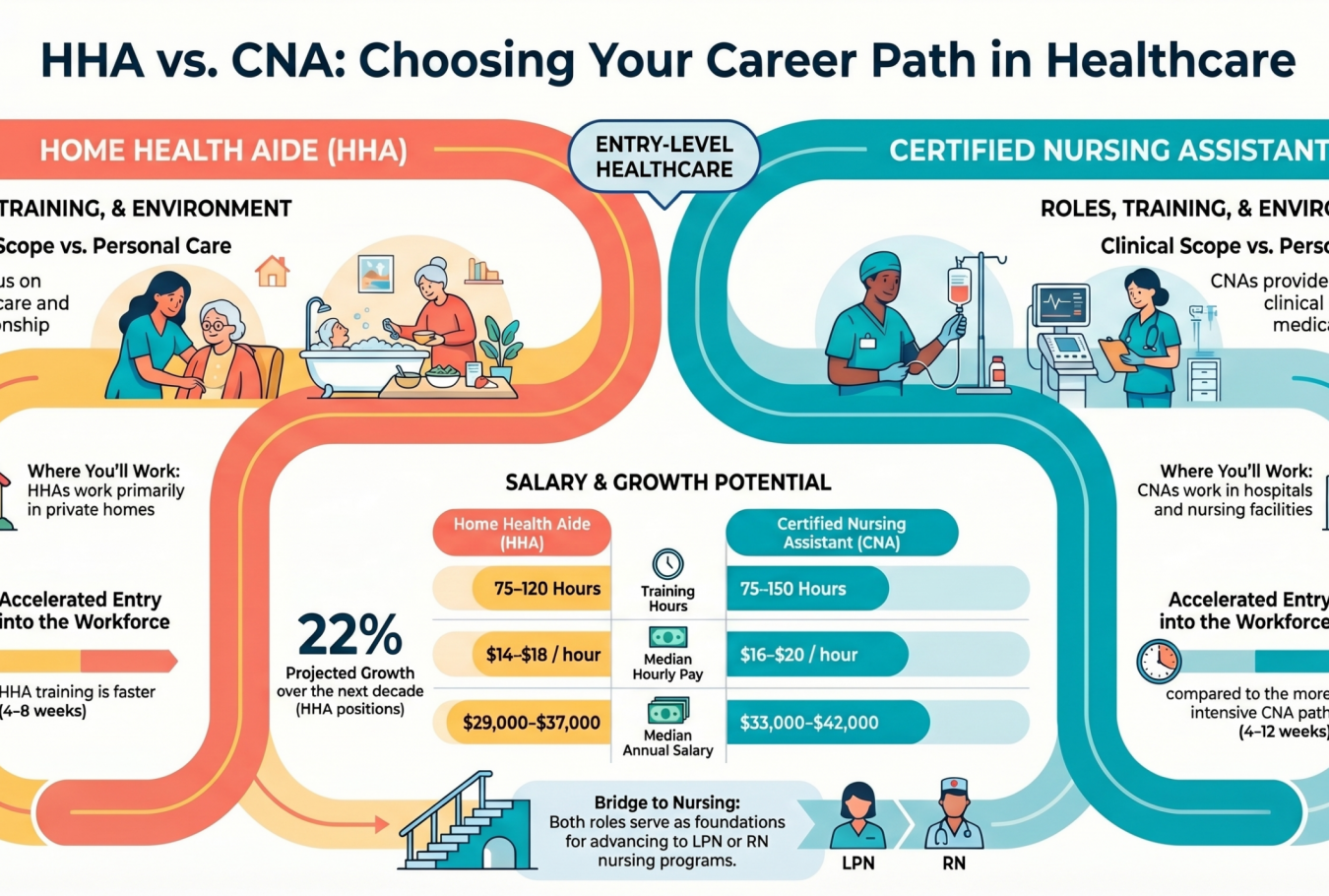
An HHA (home health aide) is trained to provide personal care and basic health monitoring to patients in their homes or community settings. A CNA (certified nursing assistant) is trained for clinical care in nursing homes, hospitals, and rehabilitation centers, with a broader scope of medical responsibility. HHA training is typically shorter and focuses on home-based care, while CNA training is more clinically intensive and facility-based.
Understanding the day-to-day responsibilities of each role is the most practical place to start. For a deeper look at the HHA role specifically, read our guide: what is a home health aide?
HHA responsibilities:
CNA responsibilities (all of the above, plus):
The key distinction is clinical scope and setting. HHAs work in home and community environments with a focus on personal care and independence. CNAs work in facility-based settings where the clinical demands are more intensive and the pace more structured. For a full breakdown of the skills that carry across both roles, read our guide on top skills for patient care workers.
| HHA | CNA | |
| Training hours | 75-120 hours | 75-150 hours (varies by state) |
| Training format | Online + skills eval | Classroom, clinical, and online options |
| Time to complete | 4 to 8 weeks | 4 to 12 weeks |
| Written exam | Yes | Yes (state-proctored) |
| Clinical skills eval | Required in most states | Required in all states |
| State registry | Required (most states) | Required in all states |
Both credentials are governed by federal CMS training standards that set minimum hour and competency requirements for aides working in Medicare and Medicaid-certified settings. States may — and frequently do — set higher minimums than the federal floor.
For full state-by-state breakdowns, see our dedicated guides:
| Credential | Typical timeline |
|---|---|
| HHA | 4 to 8 weeks |
| CNA | 4 to 12 weeks |
The timelines are similar, but CNA programs in states with higher hour requirements — like California’s 150-hour minimum — can extend the process significantly. For detailed timeline breakdowns, read our dedicated guides:
| Role | Median hourly pay | Median annual salary |
| Home health aide (HHA) | $14-$18/hour | $29,000-$37,000 |
| Certified nursing assistant (CNA) | $16-$20/hour | $33,000-$42,000 |
CNAs earn more on average, reflecting the broader clinical scope of the role and the higher training intensity required. However, experienced HHAs in high-paying states like Massachusetts, Washington, and New York can earn wages that approach the lower end of the CNA range.
Salary data sourced from the Bureau of Labor Statistics Occupational Outlook Handbook. For full state-by-state salary breakdowns for each credential, read our dedicated guides:
HHAs work primarily in:
CNAs work primarily in:
Work setting preference is one of the most important factors in this decision. If you value independence, one-on-one patient relationships, and working in home environments, HHA is the natural fit. If you prefer a structured team setting with stronger clinical exposure, CNA is the better match. For more context on why both roles matter to the healthcare system, read our guide on why direct care workers are critical.
Both credentials serve as legitimate launching pads into nursing and healthcare management. The path differs slightly depending on where you start.
From HHA, you can advance to:
From CNA, you can advance to:
According to the National Council of State Boards of Nursing (NCSBN), CNA experience is a recognized and valued precursor to nursing school admission. Many ADN and BSN programs actively recruit candidates with CNA backgrounds for their clinical competency foundation.
For the full career roadmap from either starting point, read our guide: HHA career path — how to advance from home health aide to RN and beyond.
| Credential | NCOOA course available |
|---|---|
| Home health aide (HHA) | Yes — NCOOA HHA online course |
| Certified nursing assistant (CNA) | Yes — NCOOA CNA exam prep course |
| Personal care assistant (PCA) | Yes — NCOOA PCA online course |
| Direct care worker (DCW) | Yes — NCOOA DCW online course |
| Personal care worker (PCW) | Yes — NCOOA PCW online course |
All programs are fully online, self-paced, and aligned with federal CMS training standards. Browse all NCOOA caregiver certification programs to compare options in one place.
Choose HHA if:
Choose CNA if:
Not sure if either credential is the right starting point? Read our guide on can you be a caregiver without certification? for a broader look at entry points into the caregiving field.
Is HHA or CNA training harder?
CNA training is generally more clinically demanding. The written exam is more comprehensive, and the skills evaluation covers a broader range of clinical procedures. HHA training is highly accessible for people with no medical background and is easier to complete entirely online. Both are very manageable for motivated students. Visit the NCOOA FAQ page if you have specific questions about either program before enrolling.
Can an HHA become a CNA?
Yes. Many HHAs pursue CNA certification after gaining experience, and the patient care foundation built as an HHA makes CNA training more approachable. Some programs offer accelerated pathways for current HHAs. NCOOA’s CNA exam prep course is fully online and self-paced, making it a natural next step for working HHAs.
Which certification is in higher demand?
Both are in strong and growing demand. According to the Bureau of Labor Statistics, home health aide employment is projected to grow 22 percent through 2032. CNA demand is equally strong, particularly in nursing facilities, hospitals, and rehabilitation centers serving an aging population.
How does online training work for each credential?
Both HHA and CNA knowledge curricula can be completed online. The clinical skills evaluation for both requires an in-person component arranged through your state’s testing process. For more detail on online training acceptance, read our guide: is online HHA training accepted?
What if I want to pursue both credentials eventually?
Many healthcare professionals hold both. Starting with HHA gets you into the workforce faster, while CNA adds clinical breadth and opens facility-based roles. NCOOA offers both programs — you can enroll in the HHA course now and add the CNA prep course when you are ready to advance.
A career as a home health aide offers steady employment, genuine purpose, and a clear entry point into the broader healthcare field. With online training through NCOOA, you can earn your certification on your own schedule.