One of the first things people ask when they consider becoming a home health aide is how long the whole process takes. Most people exploring HHA training are balancing work, family, and other commitments, and they need to know whether this is realistic for their life right now.
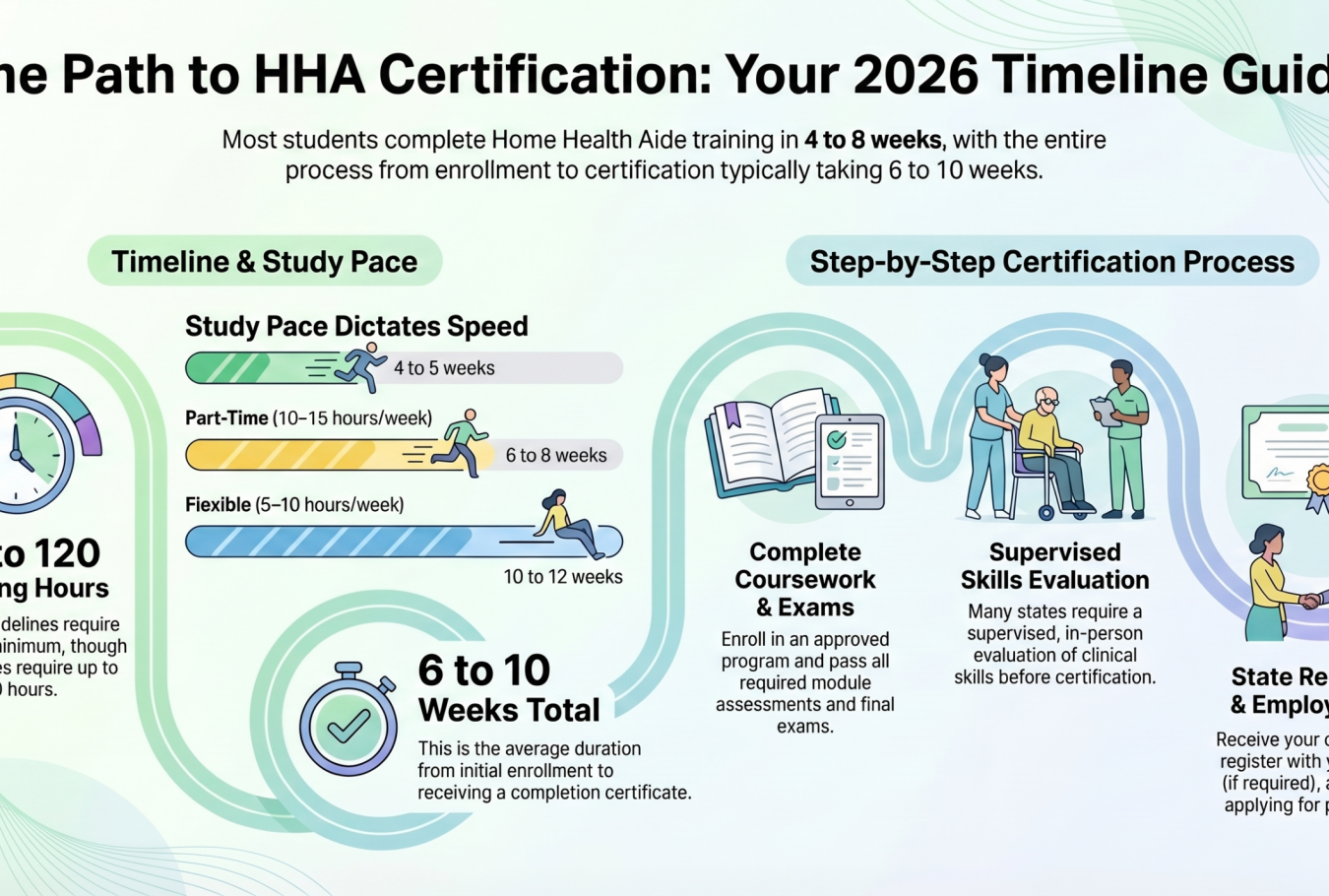
Most HHA programs require between 75 and 120 training hours depending on the state. Online students who study consistently can complete the coursework in 4 to 8 weeks. The total time from enrollment to certification is typically 6 to 10 weeks for most students.
1. Your state’s minimum hour requirements
Federal CMS guidelines set a floor of 75 training hours for HHAs working in Medicare and Medicaid-certified agencies. Many states require more. California requires 120 hours. Some states require as few as 40. The number of hours your state mandates is the single biggest factor in your overall timeline.
For a full state-by-state breakdown of training hour requirements, see our HHA certification requirements by state guide before enrolling.
2. Your weekly study schedule
Online programs are self-paced, which means your schedule drives your timeline entirely. A student who commits 20 hours per week finishes significantly faster than one studying 8 hours per week. NCOOA’s home health aide online course is built for exactly this kind of flexibility study when your schedule opens up, and move as fast or as steadily as your life allows.
3. The skills evaluation requirement
Most states require a supervised in-person skills evaluation before certification is complete. Scheduling that evaluation through your state’s approved testing process adds time to the overall timeline , typically one to three weeks depending on availability in your area. For more detail on how states handle the skills evaluation, read our guide: is online HHA training accepted?
| Study pace | Hours per week | Estimated weeks to complete |
| Full-time study | 20-25 hours | 4 to 5 weeks |
| Part-time study | 10-15 hours | 6 to 8 weeks |
| Flexible/slow pace | 5-10 hours | 10 to 12 weeks |
These estimates are based on a 75-hour program. Students in states with higher hour requirements such as California’s 120-hour minimum, should add proportionally more time. The clinical skills evaluation and registry registration are not included in the study pace estimates above and typically add one to three weeks to the total process.
For a practical look at what to expect when you start applying for jobs, read our guide on HHA interview questions and how to prepare.
One of the most compelling aspects of the HHA credential is how quickly it can be earned compared to other healthcare roles.
| Credential | Typical training time |
|---|---|
| Home health aide (HHA) | 4 to 10 weeks |
| Certified nursing assistant (CNA) | 4 to 12 weeks |
| Personal care assistant (PCA) | 2 to 6 weeks |
| Licensed practical nurse (LPN) | 12 to 18 months |
| Registered nurse (RN) | 2 to 4 years |
HHA certification is one of the fastest entry points into patient care available anywhere in healthcare. For a full comparison of credentials, training timelines, and earning potential, read our guide: CNA vs HHA vs PCA — what’s the difference?
If you are specifically weighing HHA against CNA as your starting credential, our focused comparison guide HHA vs CNA — which certification is right for you? covers both paths in detail.
Once you receive your HHA completion certificate and complete any required state registry steps, you are ready to apply for positions. According to the Bureau of Labor Statistics, HHA employment is projected to grow 22 percent through 2032 — meaning qualified, certified candidates are consistently in demand across every state.
Most newly certified HHAs are hired within one to three weeks of beginning their job search. For a realistic look at earning potential once you are working, read our home health aide salary guide.
Certification is also just the beginning of a longer career path. Many HHAs go on to earn CNA certification, direct care worker (DCW) credentials, or advance further into nursing. For the full picture of where this career can lead, read our guide: HHA career path — how to advance from home health aide to RN and beyond.
Yes, in some states. Students in Florida, Georgia, or Illinois — where the state minimum is 40 hours — who study full-time can complete the coursework in two to three weeks. Add time for the skills evaluation and registry steps. For more detail on state-specific timelines, see our HHA certification requirements by state guide.
For agencies that accept federal Medicare and Medicaid reimbursement, 75 hours meets the federal minimum standard. However, some states and private employers require more. Always verify with your state and your target employer before assuming 75 hours is sufficient.
After completing your coursework and any required evaluations, you receive your NCOOA completion certificate. You then register with your state registry if required and begin applying for positions. For common post-certification questions, visit the NCOOA FAQ page.
Both credentials take roughly the same amount of time — 4 to 12 weeks depending on state requirements and study pace. The key differences lie in clinical scope, work setting, and earning potential rather than training length. Read our HHA vs CNA comparison for the full breakdown.
Online training is typically faster for motivated, self-directed learners because you are not locked into a fixed classroom schedule. You can study every day if your schedule allows, compressing the timeline significantly. For more on how online training works and which states accept it, read our guide: is online HHA training accepted?
Many HHAs expand their credentials with personal care worker (PCW) or personal care assistant (PCA) training alongside or after HHA certification. Browse all NCOOA caregiver programs to plan your credential pathway. For information on why direct care roles matter at every level, read our guide on why direct care workers are critical.
A career as a home health aide offers steady employment, genuine purpose, and a clear entry point into the broader healthcare field. With online training through NCOOA, you can earn your certification on your own schedule.