
80+ hrs
Of personal care education
Self-paced instruction covering every essential PCA skill — complete on your schedule with no fixed deadlines.
Begin your caregiving journey with the Personal Care Assistant (PCA) Online Course from The National Caregiver Organization. Learn how to provide essential daily living assistance, promote independence, and offer compassionate care to those in need. Enroll today to start a flexible, rewarding career dedicated to improving the lives of others.
Course overview
Built around the full spectrum of PCA competencies — from hands-on ADL assistance to safety, communication, and compassionate end of life support.
80+ hrs
Self-paced instruction covering every essential PCA skill — complete on your schedule with no fixed deadlines.
127+
Video lessons and skill demonstrations across every PCA competency area — plus 5 knowledge quizzes with unlimited retakes.
100%
From any phone, tablet, or laptop — no classroom, no commute. Available in over 100 languages.
Three powerful reasons to enroll
Whether you want to get paid through Medicaid, offer private personal care services, or launch a healthcare career — the PCA Online Course gives you the professional foundation for just $64.99.
Many states allow family members to be paid caregivers through Medicaid self-direction programs — including CDPAP in New York and Adult Foster Care in other states. Most require formal PCA training as a condition of eligibility.
Private-pay personal care is one of the most in-demand services in America as the population ages. Your PCA credential demonstrates to private clients and families that you have the professional training to provide safe, competent personal care independently.
The PCA credential is a recognized, respected entry point into the US healthcare workforce. No prior experience required — and from PCA you can advance to HHA, CNA, LPN, and beyond. Enter one of America's fastest-growing industries for just $64.99.
The PCA role
A personal care assistant provides compassionate, hands-on support for clients who need help with activities of daily living (ADLs) — the fundamental tasks that allow people to live safely and comfortably at home. PCAs focus on personal care, hygiene, safety, nutrition, and emotional wellbeing.
What are ADLs?
Activities of daily living (ADLs) are the essential personal care tasks most people perform independently — bathing, dressing, grooming, eating, mobility, and toileting. When illness, disability, or aging prevents independent ADL completion, a trained personal care assistant steps in to provide skilled assistance while preserving the client's dignity and comfort.
Assisting with bathing, showering, oral care, hair care, shaving, and nail care while preserving client dignity.
Helping clients dress and undress appropriately, manage fasteners, and care for adaptive clothing and footwear.
Safe repositioning, transfers between bed and wheelchair, fall prevention, and assistive device support.
Preparing nutritious meals, assisting with feeding, supporting special dietary requirements, and encouraging hydration.
Measuring blood pressure, pulse, temperature, and respirations to monitor health and report changes to supervising nurses or family.
Providing meaningful social interaction, conversation, recreational activities, and emotional presence that improves wellbeing.
Identifying home safety risks, fall prevention strategies, emergency response readiness, and light housekeeping.
Accurately recording care activities, noting health changes, and communicating effectively with families and supervisors.
PCA care is non-medical by nature. Personal care assistants provide hands-on support for daily living — they do not diagnose, prescribe, or perform clinical nursing procedures. This makes the PCA role highly accessible for people without a medical background.
Who it's for
From complete beginners to family caregivers seeking formal recognition — the PCA Online Course meets students at every stage of their personal care journey.
Many Medicaid self-direction programs and CDPAP require PCA training — this course helps you meet that requirement so you can be paid to care for a loved one.
Providing personal care privately to elderly or disabled clients? The PCA credential formalizes your skills and builds client trust.
No experience needed. The PCA credential is a widely recognized first step into the healthcare workforce — advance from here to HHA, CNA, and beyond.
Already providing companion or non-medical home care? Upgrade to a full PCA credential and expand the personal care services you can offer.
Transitioning into healthcare from another field? Direct personal care offers a meaningful, stable, and growing career path with flexible schedules.
Hospital, senior centre, or community volunteers who want to formalize their caregiving skills with a recognized professional certificate.
Course syllabus
The curriculum covers every personal care competency a PCA needs — from hygiene and mobility assistance to nutrition, safety, mental health awareness, and compassionate end of life support.
15
Topics
127
Lessons
5
Quizzes
80%
Min. passing grade
How it works
Entirely online, self-paced, and accessible 24/7. Most dedicated students complete the course within a few weeks.
Register via secure PayPal checkout. Get instant access to all 127 lessons, quizzes, and free CPR training.
Study all 15 topics at your own pace — 24/7, from any device. One full year of access from enrollment.
Score 80% or higher. Unlimited retakes included — take your time until you're ready and confident.
Your PCA Certificate of Completion is emailed within 3 to 5 business days — ready to share with clients, families, or Medicaid programs.
Trustpilot Reviews
Read verified reviews and student feedback on Trustpilot before enrolling.
View NCOOA on Trustpilot →PCA course — frequently asked questions
Answers about the course, what personal care assistants do, Medicaid and CDPAP eligibility, how much PCAs earn, and how the PCA role compares to HHA and CNA.
NCOOA's Personal Care Assistant Online Course includes detailed video lessons and skill demonstrations across all core PCA competencies. The curriculum covers 15 topics across 127 lessons, including:
Free CPR training and free Basic First Aid training are included at no additional cost. You have one full year of access, unlimited test retakes, and a minimum passing grade of 80%.
The Personal Care Assistant Online Course is a one-time payment of $64.99. That includes all PCA skills and ADL techniques, all practice tests, a free CPR course, free Basic First Aid training, and one full year of access. There are no subscription fees, no hidden costs, and no additional purchases required.
The PCA Online Course includes 80 hours of instruction and is entirely self-paced. The speed you complete it depends entirely on how many hours per day you study. Most students complete it within a few weeks of consistent study. You have one full year of access from enrollment — no pressure, no deadlines.
Yes. Upon completing all course modules and passing the final exam with a minimum score of 80%, you will receive a PCA Certificate of Completion from National Caregiver Organization. It will be emailed within 3 to 5 business days of passing your exam. Your free CPR and Basic First Aid training completion is noted on the same certificate.
Unlimited retakes are included — there is no penalty for retrying the exam.
No prior medical experience or educational background is required. The PCA Online Course starts with foundational caregiving concepts and builds progressively. It is designed for complete beginners — including people who have never worked in healthcare. Students must be at least 18 years of age to enroll.
A personal care assistant (PCA) provides non-medical, hands-on personal care support to elderly, disabled, or chronically ill individuals, helping them perform activities of daily living (ADLs) they can no longer complete independently. PCA work is personal, dignified, and meaningful — centered on preserving the client's comfort and independence at home.
Day-to-day PCA duties include:
PCAs do not perform clinical nursing tasks — they focus on the personal care, comfort, and dignity of their clients.
Many private home care companies and independent employers accept a PCA Certificate of Completion as evidence of foundational personal care training for non-Medicare, private-pay roles. Acceptance policies vary by employer, state, and program. We recommend verifying with your specific target employer or Medicaid program before enrolling to confirm their requirements.
Our PCA course is particularly well-suited for private-duty personal caregiving, family caregiving, Medicaid self-direction programs, and CDPAP arrangements.
Yes. The entire NCOOA website and all course content are available in over 100 languages. Simply click the grey box in the bottom right corner of the website and select your preferred language. This makes professional PCA training accessible to diverse learners across the United States.
Yes — this is one of the most common reasons people enroll in the PCA Online Course. Many Medicaid self-direction programs require family caregivers to complete formal PCA training before receiving payment. The most well-known example is New York's CDPAP (Consumer Directed Personal Assistance Program), which allows a Medicaid recipient to hire a family member or friend as their paid personal care aide. Similar programs exist across most US states under various names, including:
Requirements for these programs vary significantly by state and change over time. Always contact your state's Medicaid office or Area Agency on Aging to verify that our PCA course meets your program's training requirements before enrolling.
CDPAP — Consumer Directed Personal Assistance Program — is a New York Medicaid program that allows eligible individuals with disabilities or chronic conditions to hire their own personal care aides, including family members and friends, and direct their own care. The consumer (the care recipient) acts as the employer and chooses who provides their care, rather than receiving care from an agency-assigned aide.
Key CDPAP facts:
According to the U.S. Bureau of Labor Statistics, the median annual wage for personal care aides was approximately $30,000–$33,000 in 2023, or roughly $13–$17 per hour. Pay varies by state, employer type, setting, and experience. States like New York, California, and Massachusetts typically offer higher wages due to cost of living and stronger labor standards. Private-pay PCAs working independently may set their own rates.
The PCA credential is the beginning of a clear healthcare career ladder. Common advancement paths include:
Each step builds directly on the foundational skills learned in the PCA course. Many employers offer tuition reimbursement for advancement training.
The PCA Online Course ($64.99) is the most commonly recommended NCOOA course for family caregivers pursuing Medicaid self-direction payment programs. The PCA credential is the role name used in most Medicaid consumer-directed care programs — including CDPAP in New York — which makes the PCA certificate particularly relevant for eligibility documentation purposes.
The DCW course is an equivalent alternative at the same price if the program you're applying to accepts DCW training. All NCOOA entry-level courses share the same curriculum — the difference is the credential name on your certificate. Always verify which credential your specific program accepts before enrolling.
PCAs and HHAs both provide home-based personal care — the key difference is in the scope of duties and the credential's standing with Medicare and Medicaid agencies:
| Feature | PCA | HHA |
|---|---|---|
| Primary focus | ADL assistance & personal care | Home health monitoring + personal care |
| Medical tasks | Non-medical (ADLs only) | Limited clinical tasks (vitals, reminders) |
| Medicaid family care | Widely recognized — CDPAP & waiver programs | Recognized at Medicare-certified agencies |
| State exam | Generally no | Required at Medicare agencies; not for private roles |
| NCOOA price | $64.99 | $99.99 |
If your goal is Medicaid self-direction or family caregiving, the PCA course is the most relevant choice. If your goal is home health aide work through an agency or private practice, the HHA course is the better credential.
No. A PCA (Personal Care Assistant) and a CNA (Certified Nursing Assistant) are distinct credentials with different scopes, settings, and requirements. PCAs provide non-medical personal care and ADL assistance — primarily in private homes or community settings — with no state exam required. CNAs work in clinical settings like nursing homes and hospitals, assist with broader nursing tasks under nurse supervision, and must pass a mandatory state certification exam.
PCAs cannot perform clinical nursing procedures that CNAs are trained for. If you want to work in a clinical facility or have a direct pathway to LPN and RN credentials, explore the CNA Exam Prep Course.
Both credentials involve personal caregiving and share the same NCOOA curriculum at the same price ($64.99). The primary difference is the credential name and the context in which each is most recognized:
For most Medicaid and CDPAP applications, the PCA certificate is the better choice. For entry-level career starts and entrepreneurial home care, either credential works equally well.
For a one-time payment of $64.99, get full-year access to the PCA Online Course + free CPR & First Aid training — including Medicaid and CDPAP recognized training.
To download the complete Personal Care Assistant Exam Prep Online Course Syllabus, please click the button below and fill out the form. The Complete syllabus will be sent directly to your email.
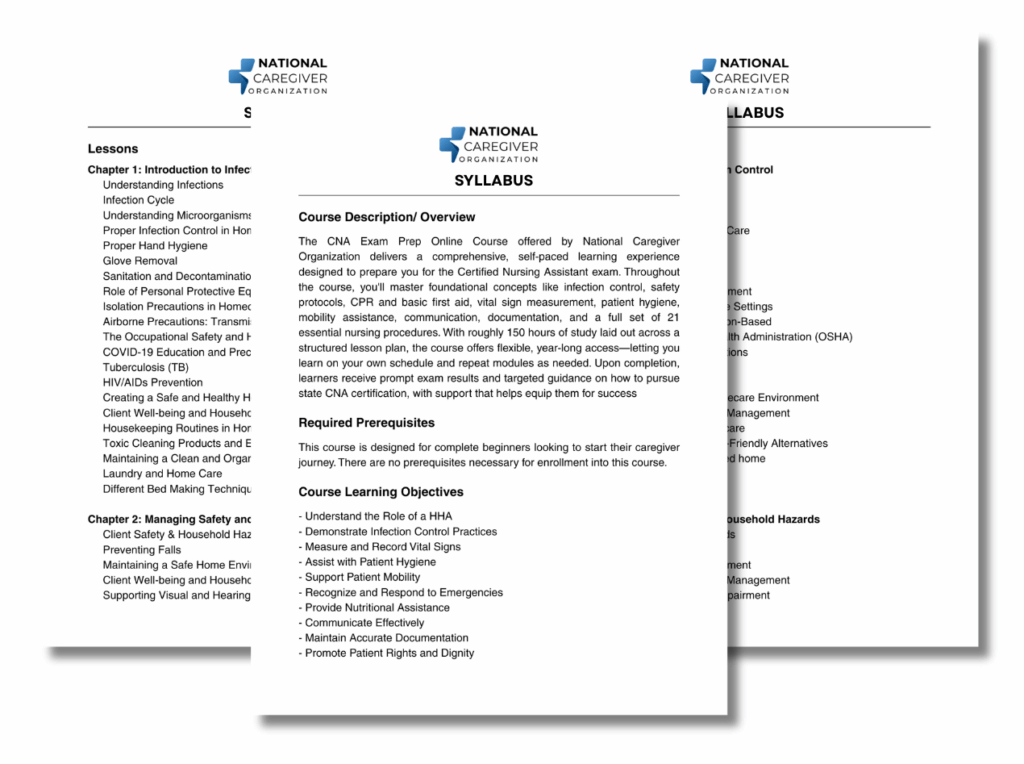
*Download this form and the above National Caregiver Organization syllabus will be emailed to your directly. By completing this form, you certify that you agree to National Caregiver Organization’s Terms and Conditions.*