
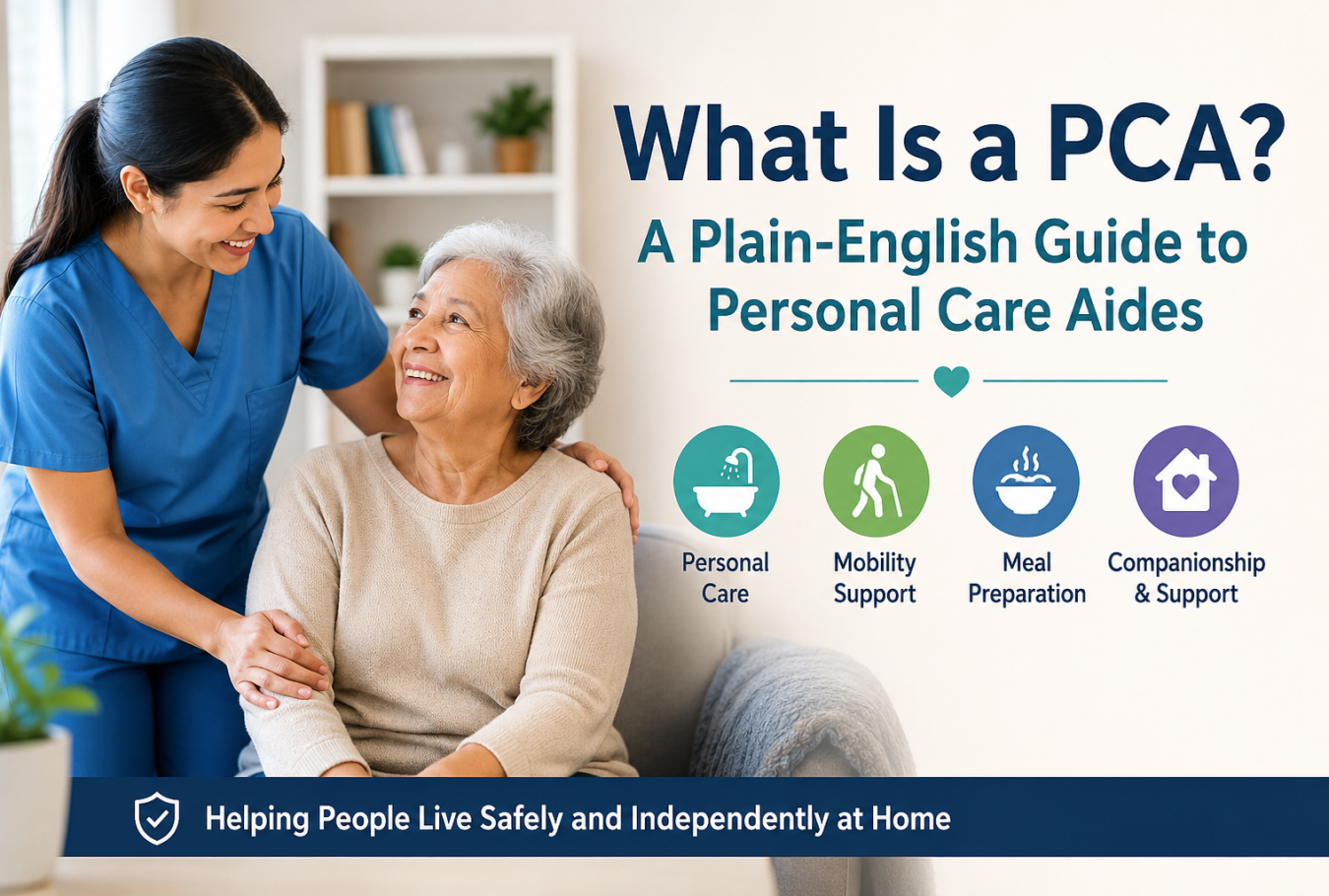
A PCA, or personal care aide, is a non-medical caregiver who helps people with daily living tasks such as bathing, dressing, grooming, toileting, meal preparation, mobility support, light housekeeping, and companionship. PCAs often support older adults, people with disabilities, recovering patients, or clients who need help staying safe and independent at home.
The PCA role is one of the most accessible entry points into caregiving. It can be a good fit if you want to work directly with clients, provide hands-on support, and build experience in home care before moving into roles such as home health aide, certified nursing assistant, personal care worker, or direct care worker.
Requirements vary by state, employer, and care setting. Online PCA training can help you build foundational knowledge and job readiness, but some employers or Medicaid-funded programs may still require additional orientation, competency checks, or state-specific training.
PCA usually stands for personal care aide, personal care assistant, or personal care attendant. The exact title depends on the state, employer, or care program, but the role usually means the same thing: helping a client with everyday personal care and home-based support.
You may also see similar titles such as:
The job title may change, but the core purpose stays similar: supporting a person’s daily routine while protecting their safety, dignity, and independence.
A PCA helps clients complete everyday tasks they may struggle to do safely on their own. The exact duties depend on the client’s care plan, the employer’s policies, and state rules.
Common PCA duties include:
| Area of Care | What a PCA May Help With |
|---|---|
| Personal care | Bathing, dressing, grooming, oral hygiene, toileting support |
| Mobility support | Walking assistance, transfers, fall prevention, repositioning |
| Meal support | Preparing simple meals, feeding assistance, grocery help |
| Home support | Laundry, light cleaning, linen changes, keeping walkways safe |
| Companionship | Conversation, emotional support, social engagement |
| Observation | Reporting changes in mood, appetite, mobility, or condition |
| Medication reminders | Reminding a client when it is time to take medication, where allowed |
A strong PCA does more than “help around the house.” They follow the care plan, notice small changes, communicate clearly, respect privacy, and help the client feel safe without taking away their independence.
This is one of the most important things to understand about the PCA role. PCAs are non-medical caregivers. That scope has real limits.
A PCA typically cannot:
If a client needs those services, they require a home health aide (HHA), a licensed practical nurse (LPN), or a registered nurse (RN). The difference matters — both for safety and for what Medicaid or Medicare will reimburse.
A PCA’s work is practical, personal, and often one-on-one. A typical visit may involve helping a client get out of bed, assisting with bathing and dressing, preparing breakfast, checking that walkways are clear, doing a load of laundry, and spending time in conversation.
For example:
A client recovering from surgery may need help transferring from bed to chair, preparing meals, and keeping the home safe while they regain strength.
An older adult with limited mobility may need bathing support, toileting assistance, fall prevention, and help moving safely around the home.
A client with early memory loss may need reminders, routine support, companionship, and careful observation for changes in behavior or safety risks.
This is why PCA training should cover more than definitions. New caregivers need to understand client dignity, infection control, body mechanics, professional boundaries, communication, fall prevention, and when to report concerns.
Most PCAs work in home-based care, but the setting can vary.
Common PCA work environments include:
The setting matters because it can affect training requirements, supervision, pay structure, documentation, and what tasks the PCA is allowed to perform.state licensing rules and the funding source (private pay, Medicaid, or a specific Medicaid waiver program).
PCA training can help prepare you for entry-level caregiving, but whether it is “enough” depends on your state, employer, and the type of care setting.
Some private-pay families may hire caregivers with little formal training. Many home care agencies, however, prefer or require documented training, orientation, background checks, and competency review. Medicaid-funded programs may also have specific training rules.
A good PCA training course should help you understand:
Online training can support job readiness, but it should not be confused with a universal license or guaranteed employment. Requirements vary.
Sometimes, but not always. PCA certification requirements vary by state, employer, and funding source.
Here is the practical way to think about it:
| Situation | Certification or Training Requirement |
|---|---|
| Private-pay family care | May not require formal certification, depending on the state |
| Home care agency work | Often requires orientation, training, or proof of completed caregiver education |
| Medicaid-funded PCA program | May require state-specific training or competency checks |
| Assisted living or facility support role | Requirements depend on facility policy and state rules |
| CNA work | Requires state-approved training and exam completion |
A PCA training certificate usually shows that you completed a caregiver education program. It is not always the same as a state license, CNA certification, or state-approved clinical training.
Before applying, check the employer’s requirements and your state’s Department of Health, Medicaid office, or relevant care workforce rules.
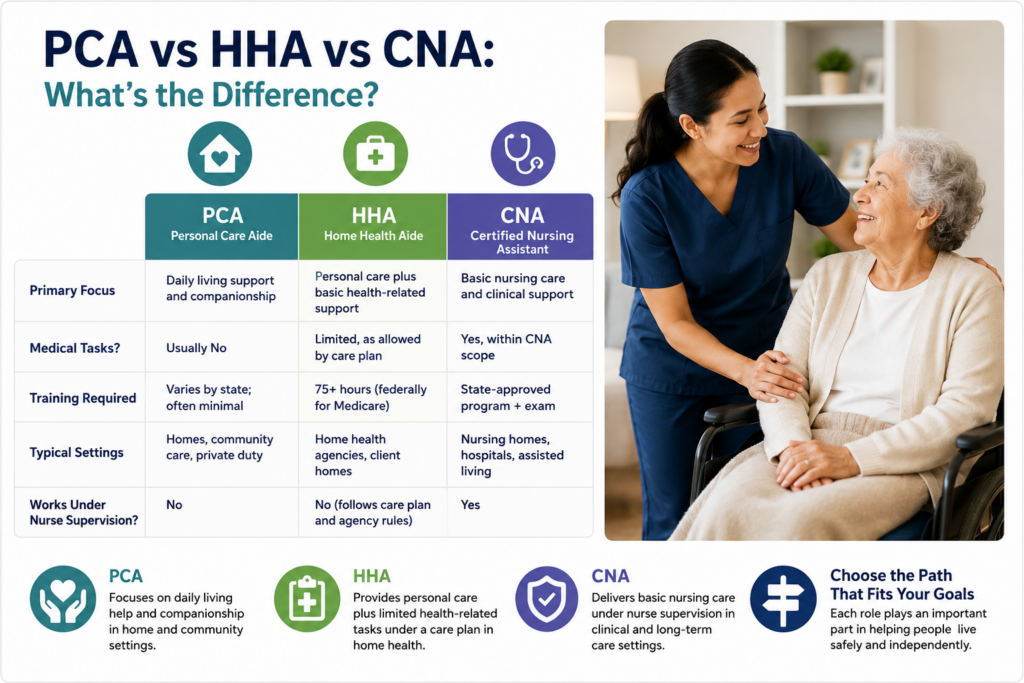
The biggest difference is scope of care. PCAs usually provide non-medical personal care. HHAs may provide some health-related support under a care plan. CNAs complete state-approved training and work under nurse supervision in more clinical settings.
| Role | Full Title | Main Focus | Medical Tasks? | Typical Setting |
|---|---|---|---|---|
| PCA | Personal Care Aide | Daily living support and companionship | Usually no | Home care, private-duty care, community care |
| HHA | Home Health Aide | Personal care plus limited health-related support | Sometimes, depending on rules and care plan | Home health agencies, Medicare/Medicaid care |
| CNA | Certified Nursing Assistant | Basic nursing support under nurse supervision | Yes, within CNA scope | Nursing homes, hospitals, long-term care, assisted living |
You want an entry-level caregiving role focused on personal care, companionship, home support, and helping clients remain independent.
You want to work in home health and may need training for basic health-related support under a formal care plan.
You want a more clinical pathway, plan to work in nursing homes or hospitals, or want a stepping stone toward nursing.
For CNA content, it is important to remember that CNA exam prep is not the same as completing a state-approved CNA training program or required clinical hours, where those apply.
The PCA role is best for someone who is patient, dependable, respectful, and comfortable helping people with personal daily care.
You may be a good fit if you:
You may want to consider another pathway if:
In that case, HHA, CNA, or nursing assistant pathways may fit your goals better.
Employers usually want caregivers who are reliable, safe, respectful, and trainable. Experience helps, but attitude and consistency matter a lot in entry-level caregiving.
Important PCA skills include:
A new PCA does not need to know everything on day one. But they should understand the basics, know their limits, and ask for help before doing anything outside their role.
Many beginner mistakes happen because new caregivers want to help but do not yet understand role boundaries.
Avoid these common mistakes:
Before your first client visit, you should understand the care plan, your allowed duties, emergency procedures, and who to contact if something changes.
A simple first-visit readiness checklist:
The goal is not to be perfect immediately. The goal is to be safe, respectful, observant, and willing to learn.
PCA pay varies by state, employer, funding source, experience, and schedule. Private-duty care, agency work, Medicaid-funded programs, overnight shifts, live-in arrangements, and weekend coverage may all pay differently.
In general, pay can be influenced by:
For accurate pay expectations, check current job listings in your area and compare agency roles, private-pay roles, and Medicaid-funded PCA programs.
To become a PCA, start by checking your state and employer requirements, complete relevant caregiver training, and apply for entry-level home care roles.
A practical pathway:
NCOOA’s online caregiver training can help learners build foundational knowledge before entering care work. The right course depends on your career goal, employer requirements, and the care setting you want to work in.
The best caregiver course depends on the role you want.
| Your Goal | Training Path to Consider |
|---|---|
| Start in basic home care | PCA training |
| Work in home health with more structured care duties | HHA training |
| Prepare for a clinical support role | CNA exam prep and state-approved CNA pathway |
| Support clients with daily living in community care | PCW or DCW training |
| Build general caregiver confidence | Foundational caregiver training |
| Improve emergency readiness | CPR and basic first aid training |
A smart approach is to choose the training that matches your next job, not just the most advanced-sounding course.through NCOOA gives you the foundational knowledge to begin — at your own pace, in your own time.
A PCA is a type of caregiver. The word “caregiver” is broad and can include PCAs, HHAs, CNAs, family caregivers, companion caregivers, and direct care workers. A PCA usually refers to a paid caregiver who provides non-medical personal care and daily living support.
No. A PCA provides non-medical support with daily living tasks. A CNA completes state-approved training, passes a competency exam, and works under nurse supervision. CNAs can usually perform basic nursing-related tasks that PCAs cannot.
Usually, a PCA can provide medication reminders but not administer medication. Rules vary by state and employer. If a client needs medication administration, wound care, injections, or skilled nursing support, another trained or licensed professional may be required.
PCA training can make you more prepared and may make your application stronger, especially for entry-level home care roles. However, it does not guarantee employment. Employers may still require interviews, background checks, orientation, and state-specific training.
It depends on the state, employer, and training program. Some PCA training can be completed quickly, while certain Medicaid-funded programs or employers may require more structured instruction and competency review.
In some states and programs, yes. Consumer-directed care and Medicaid waiver programs may allow eligible clients to hire family members as paid caregivers. Rules vary widely, so families should check their state Medicaid program or care coordinator.
Online PCA training can be useful for building foundational caregiving knowledge and job readiness. Whether it satisfies a specific employer, Medicaid program, or state requirement depends on that program’s rules.
After PCA training, you can apply for entry-level caregiving roles, complete employer orientation, and consider additional training such as HHA, CNA exam prep, CPR, basic first aid, dementia care, or direct care worker training.