

he best way to study for the CNA exam is to prepare for both parts of the test: the written or oral knowledge exam and the hands-on clinical skills evaluation. Most candidates fail because they only study definitions or only practice skills. You need both: exam-style question practice and repeated clinical skill walkthroughs using your state’s official checklist.
The CNA exam is the final step after completing an approved nursing assistant training program. It confirms that you understand basic patient care, safety, communication, infection control, resident rights, and hands-on nursing assistant procedures.
Because CNA exams are regulated at the state level, the exact format, testing vendor, number of questions, passing score, retake rules, and clinical skills list can vary. Before you study, confirm your state’s current exam handbook through your state nurse aide registry, department of health, or approved testing vendor. NCSBN states that it no longer develops or owns the NNAAP exam and directs candidates to contact their state agency or Credentia for current exam information.
The CNA exam usually has two parts:
| Exam Part | What It Tests | How to Prepare |
|---|---|---|
| Written or oral knowledge test | Patient care, resident rights, infection control, safety, communication, personal care, vital signs, nutrition, documentation, and basic nursing assistant duties | Use practice questions, review course notes, study weak topics, and take timed practice tests |
| Clinical skills evaluation | Hands-on nursing assistant procedures performed in front of an evaluator | Practice each skill step by step using your state’s official skills checklist |
In many states, the written section includes multiple-choice questions, while the clinical section requires you to demonstrate selected nursing assistant skills. Prometric’s clinical skills checklist, for example, states that its clinical skills test includes five scored skills, with handwashing and indirect care included in scoring.
The CNA written exam tests whether you understand the knowledge needed to provide safe, respectful, basic patient care. It is not designed to test advanced nursing theory. It focuses on what a nursing assistant must know in real care settings.
Common topics include:
Some candidates may be able to take an oral version of the exam depending on their state rules and approved accommodations. Do not assume this is automatic. Check your state testing handbook before registration.
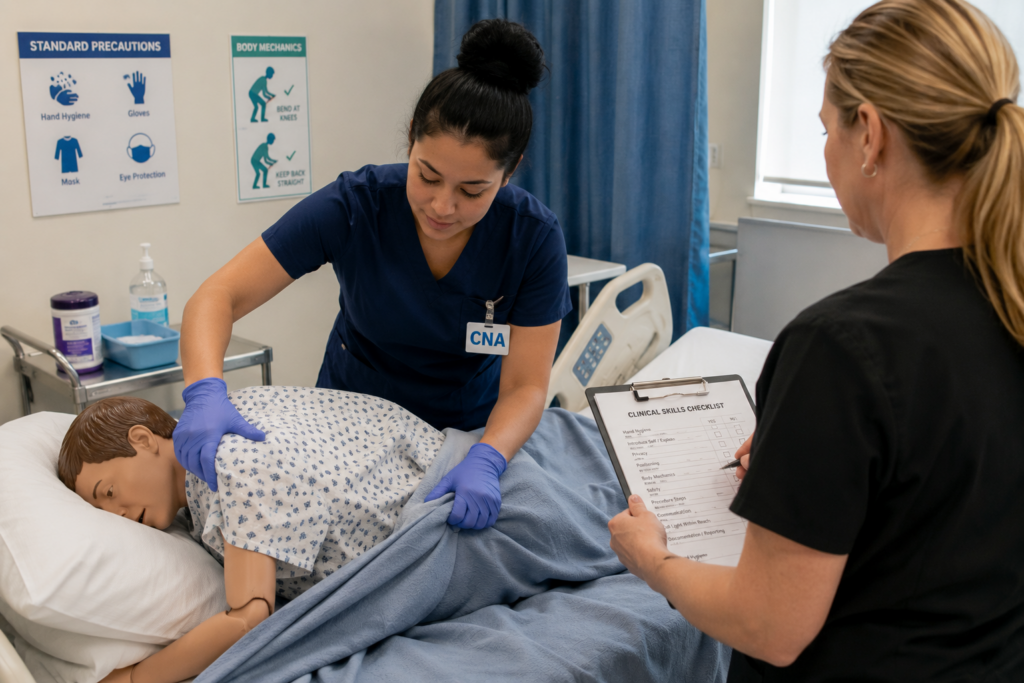
The CNA clinical skills test checks whether you can safely perform hands-on nursing assistant tasks in the correct order. This section is usually more stressful than the written exam because you must demonstrate skills in front of an evaluator.
You may be asked to perform skills such as:
The exact skills list depends on your state and testing vendor. Prometric’s generic clinical checklist confirms that clinical skills are scored using required steps, which means missing a critical step can cost you the skill even if you mostly know what to do.
A good CNA study plan should move from content review to active practice to final exam simulation. Do not spend all your time rereading notes. The exam rewards recall, procedure memory, and confidence under pressure.
Start by reviewing the material from your CNA training course. Your course materials should be your primary source because approved training programs are built around the same core knowledge areas tested on the exam.
Focus on:
Your goal in this phase is not to memorize every sentence. Your goal is to understand the “why” behind CNA actions: why privacy matters, why hand hygiene is repeated, why body mechanics prevent injury, and why changes in condition must be reported quickly.
The skills test requires you to demonstrate a set of nursing assistant procedures before a trained evaluator. You will typically be asked to perform 5 skills drawn randomly from your state’s standardized list — which usually includes 25–30 possible procedures.
Common skills tested include handwashing, measuring and recording vital signs, assisting with repositioning, providing perineal care, and ambulation assistance. The evaluator scores each skill using a standardized checklist — every required step must be completed correctly to receive credit.
Practice questions help you identify what you do not know before test day. They are most useful when you review the explanations, not just the score.
Use timed practice tests to build speed and confidence. After each test, sort your mistakes into categories:
| Mistake Type | What It Means | What to Do |
|---|---|---|
| Knowledge gap | You did not know the fact or rule | Review that topic again |
| Misread question | You knew the answer but rushed | Slow down and underline key words |
| Two answers seemed right | You need better decision-making | Choose the safest, most resident-centered answer |
| Repeated same topic errors | Weak content area | Study that topic deeply for 1–2 days |
Most CNA written exam questions reward safe, respectful, practical care. When unsure, look for the answer that protects the resident’s safety, dignity, privacy, and rights.
The best way to prepare for the clinical skills test is to practice each skill out loud from start to finish. You are training your body and memory to follow the correct sequence under pressure.
For each skill:
Do not only practice the “big” part of the skill. Many candidates lose points on small but required steps such as privacy, safety checks, communication, call light placement, or hand hygiene.
The highest-priority CNA exam topics are resident rights, infection control, safety, communication, personal care, and basic observation. These topics appear often because they affect patient safety and quality of care.
You need to understand privacy, confidentiality, informed choice, respectful care, freedom from abuse, and the right to refuse care. CNA questions often test whether you know how to protect dignity during bathing, toileting, dressing, and end-of-life care.
Expect questions about hand hygiene, gloves, masks, gowns, standard precautions, isolation precautions, contaminated linens, sharps safety, and preventing the spread of infection.
Study fall prevention, fire response, choking, seizures, restraint alternatives, safe transfers, wheelchair safety, and when to report changes to a nurse.
Know how to report objective observations, avoid giving medical advice, communicate with confused residents, document care accurately, and escalate concerns.
Review bathing, oral care, grooming, dressing, toileting, skin care, pressure injury prevention, and assisting residents while maintaining independence.
Understand normal measurement methods, what to report, and how to notice changes in condition. CNAs do not diagnose, but they are expected to observe and report accurately.
Study feeding assistance, aspiration risk, fluid intake, special diets, dehydration signs, and resident preferences.
Know how to respond calmly to confusion, agitation, repetitive questions, wandering, depression, and behavior changes.
To pass the CNA skills test, focus on safety, infection control, privacy, communication, and correct sequence. The evaluator is not only watching what you do. They are watching whether you provide care like a safe nursing assistant.
Use these rules for almost every skill:
If you make a mistake, do not panic. Correct it as soon as you notice. Staying calm matters because CNAs must be able to recover safely in real care situations.
The most common CNA exam mistakes are rushing, ignoring the official checklist, and underestimating the clinical skills section. Candidates often know the material but lose points because they skip required steps.
| Mistake | Why It Hurts Your Score | Better Approach |
|---|---|---|
| Only studying practice questions | You may pass written practice but fail skills | Balance written review with daily skills practice |
| Practicing skills from memory too early | You may memorize the wrong sequence | Use the official checklist first |
| Skipping hand hygiene | Infection control is heavily scored | Build handwashing into every skill routine |
| Forgetting privacy | Privacy is part of resident rights | Always close curtains, drape, and explain care |
| Rushing through questions | Easy mistakes reduce your score | Read every question carefully |
| Studying every topic equally | Weak areas stay weak | Track errors and study the highest-risk topics first |
Most candidates should study for 3–6 weeks after training, depending on confidence and test date. If your exam is soon, focus less on reading and more on active recall, practice questions, and clinical skill repetition.
A simple weekly structure:
| Time Before Exam | Main Focus |
|---|---|
| 4–6 weeks out | Review content areas and begin skills practice |
| 2–3 weeks out | Take timed practice tests and drill weak skills |
| Final week | Simulate exam conditions and refine checklist steps |
| Day before exam | Light review, prepare documents, rest |
| Exam day | Stay calm, read carefully, and follow safety steps |
The final week should be used for review and confidence-building, not learning everything from scratch.
Do this:
Do not cram late into the night before the exam. Fatigue makes both written questions and clinical skills harder.

Bring the exact identification, confirmation documents, and supplies required by your testing vendor or state handbook. Requirements vary, so do not rely on a generic list.
Common items may include:
Check your candidate handbook before test day. Rules around clothing, phones, bags, and personal items can differ by testing site.
NCOOA’s CNA prep course can support exam preparation by giving candidates a structured way to review core CNA topics before test day. A good prep course should help students organize the material, reinforce weak areas, and connect written knowledge with clinical practice.
Based on the draft information provided, NCOOA’s CNA prep course covers 15 core content areas aligned with CNA exam preparation, including infection control, patient rights, dementia communication, and end-of-life care. The draft also states that the course is self-paced, includes one year of access, and includes CPR and Basic First Aid training.
Before publishing, I would verify the course benefits, access period, and included certifications against the current NCOOA course page so the article does not accidentally publish outdated offer details.
The number of questions depends on your state and testing vendor. Many CNA written exams use multiple-choice questions covering patient care, safety, resident rights, communication, infection control, and basic nursing assistant duties. Always check your state’s current candidate handbook before studying from a fixed question count.
The CNA exam is manageable if you prepare for both the written and skills sections. It becomes difficult when candidates only memorize facts and do not practice clinical skills in the correct sequence.
For many candidates, the clinical skills test feels harder because it requires performing care steps in front of an evaluator. The pressure can make candidates forget simple steps like hand hygiene, privacy, call light placement, or locking equipment.
Some states or vendors may offer an oral exam option or accommodations. You need to request this through the correct state agency or testing vendor before your exam date.
Retake rules vary by state. Some states limit the number of attempts before additional training is required. Check your state nurse aide registry or candidate handbook for the exact rule.
Passing scores vary by state and vendor. The written exam is usually scored separately from the clinical skills evaluation. The skills test often requires candidates to correctly complete required steps for each assigned skill.
CNA exam administration depends on the state. Some states use vendors such as Prometric or Credentia, while others may use different testing systems. NCSBN now directs candidates to state agencies or Credentia for NNAAP-related exam information.
To study for the CNA exam, prepare for the written test and the clinical skills evaluation at the same time. Use practice questions to strengthen knowledge, use your state checklist to master skills, and focus heavily on safety, infection control, communication, privacy, and resident rights.
The best CNA candidates do not just memorize answers. They learn how to think like safe, respectful nursing assistants.