If you’re thinking about starting a career in healthcare in Florida, becoming a certified nursing assistant (CNA) is one of the most rewarding first steps you can take. Florida has a high and growing demand for qualified CNAs, and the path to certification is more accessible than many people realize.
This guide walks you through everything you need to know — from the basic requirements to passing your state exam and building a career in one of the most important fields in American healthcare.
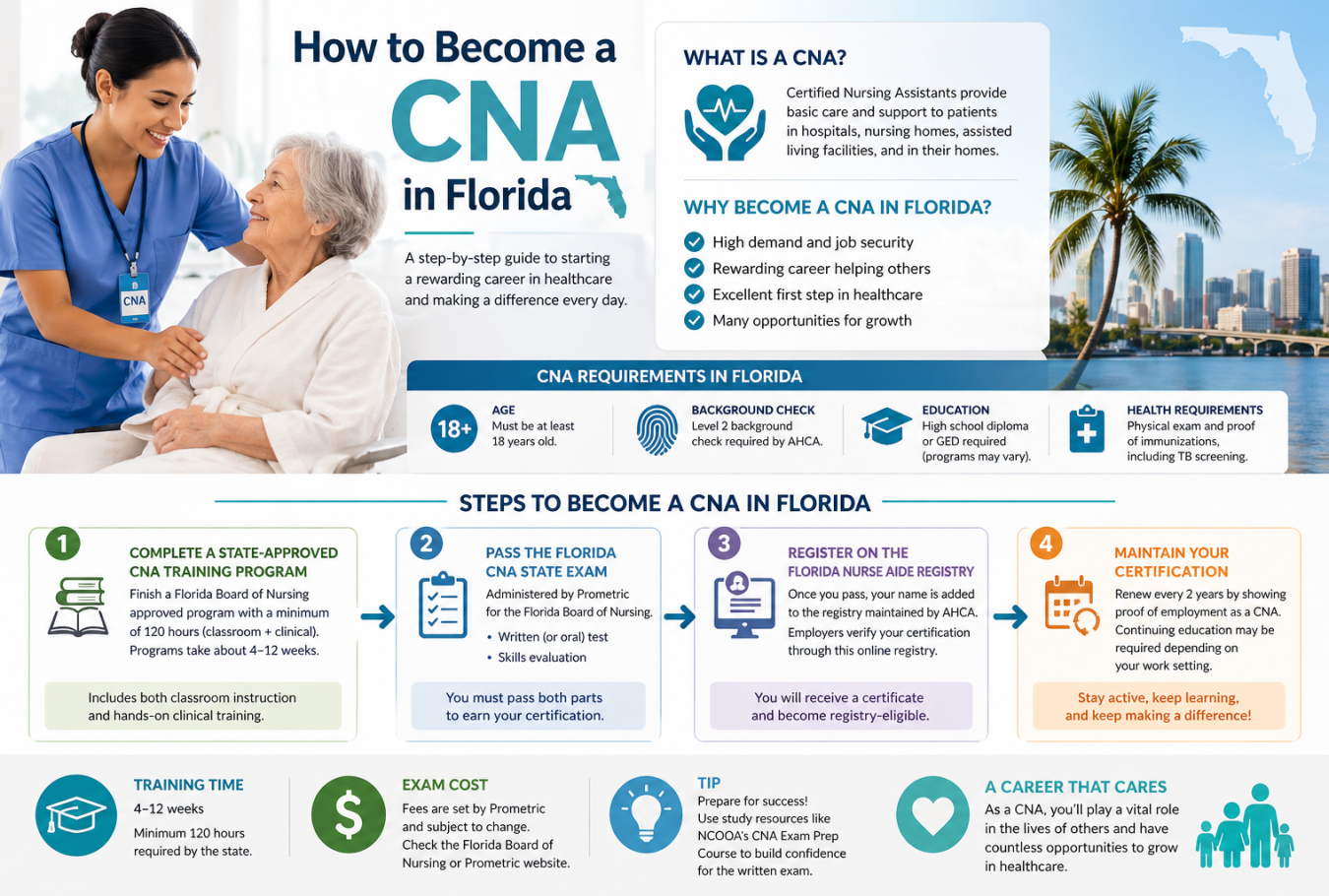
A certified nursing assistant provides direct care to patients in nursing homes, assisted living facilities, hospitals, and home settings. In Florida, CNAs assist patients with daily living activities such as bathing, dressing, mobility, meals, and vital sign monitoring, always working under the supervision of a licensed nurse.
Florida’s aging population makes CNAs essential to the state’s healthcare system. With millions of seniors living in Florida, the demand for trained, compassionate direct care workers continues to grow year after year.
Before starting your training, it helps to understand the basic eligibility requirements for becoming a CNA in Florida.
Age: You must be at least 18 years old to become a CNA in Florida, though some programs may accept applicants who are 16 or 17 with parental consent and school enrollment.
Background check: A Level 2 background check is required by the Florida Agency for Health Care Administration (AHCA). Certain criminal convictions may affect your eligibility.
Education: A high school diploma or GED is generally expected, though some programs have additional prerequisites.
Health requirements: Many employers and programs require a physical examination and proof of immunizations including TB screening.
Florida requires completion of a state-approved nursing assistant training program that meets the minimum requirements set by the Florida Board of Nursing. Programs typically include at least 120 hours of combined classroom instruction and clinical training.
Community colleges, vocational schools, and some healthcare facilities offer approved training programs. Costs, schedules, and formats vary by provider.
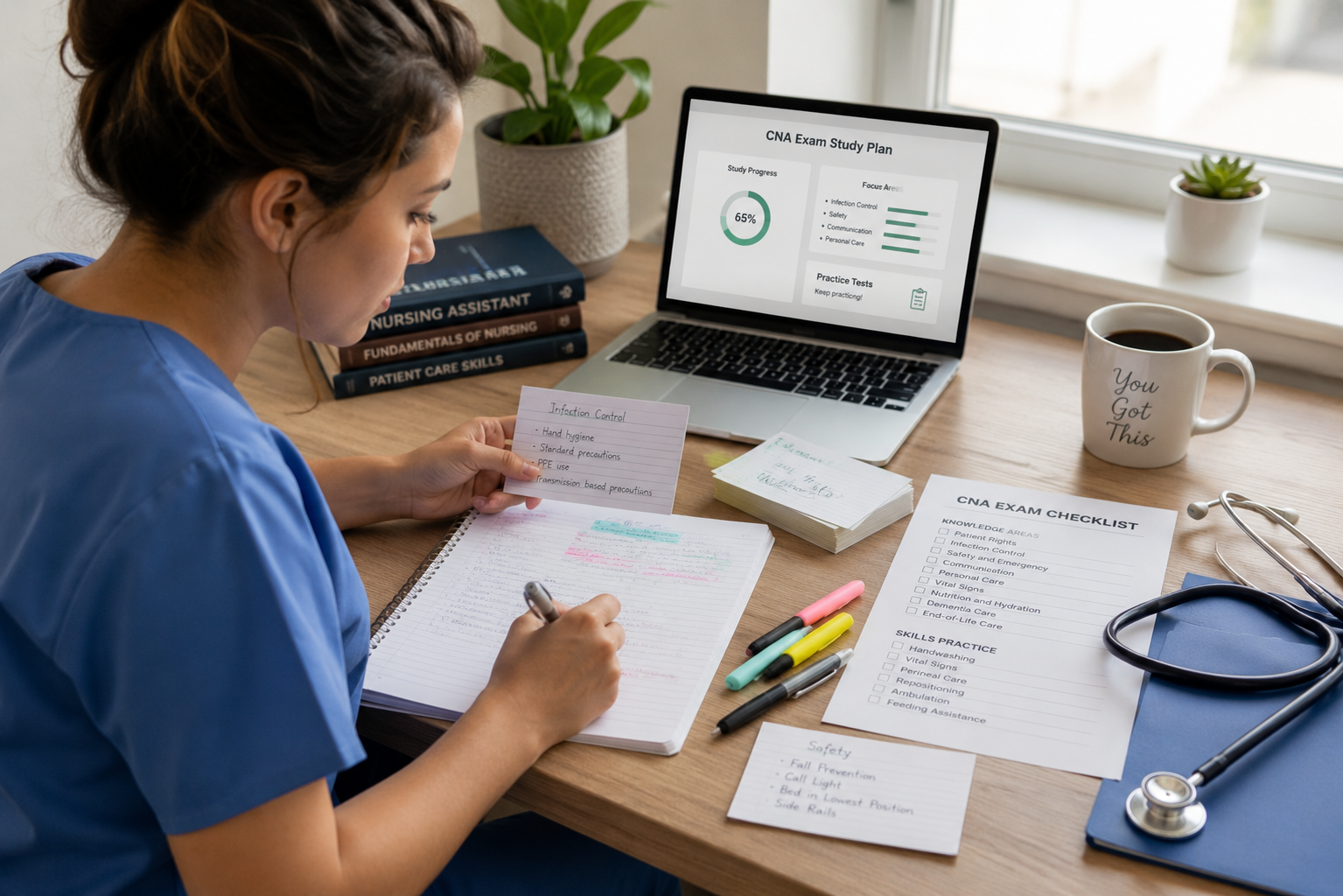
You can also use foundational online resources to supplement your preparation. NCOOA’s CNA exam prep online course is a flexible option that helps you build your knowledge base and prepare for the written portion of the Florida state exam.
After completing your training program, you must pass the Florida CNA competency exam, which is administered by Prometric on behalf of the Florida Board of Nursing. The exam has two parts:
Both parts must be passed to receive your certification. If you do not pass one part, you can retake that portion within your eligibility window.
Once you pass both parts of the exam, your name is added to the Florida Nurse Aide Registry, maintained by AHCA. Employers verify your certification status through this registry.
You will receive a certificate of completion, and your status will be searchable online.
Florida CNA certifications must be renewed every two years. To stay active, you must show proof of employment performing nursing assistant duties. Continuing education may also be required depending on your work setting.
Most state-approved CNA training programs in Florida take between four and twelve weeks to complete, depending on the format and schedule. Full-time programs run faster, while part-time or weekend programs may take longer.
The Florida-mandated minimum training hours are 120 hours, which covers both classroom and clinical components. Online study tools, including NCOOA’s nursing courses, allow you to prepare for the written exam at your own pace and in your own time.
Prometric charges a fee to take the Florida CNA competency exam. Fees can change, so always check the current fee schedule directly through the Florida Board of Nursing or Prometric’s website. Some training programs include the exam fee in their tuition, while others require students to register and pay separately.
If you need to retake one portion of the exam, you will pay a reduced retake fee.
The written portion of the Florida CNA state exam tests your knowledge across several core areas:
The skills evaluation tests your ability to perform specific hands-on tasks correctly, following infection control protocols throughout.
Preparing thoroughly for both sections significantly increases your chance of passing on the first attempt. NCOOA’s CNA exam prep course is designed to help you review the core knowledge areas covered by state competency exams and build your confidence before test day.
In Florida, candidates with certain healthcare backgrounds — such as current or former licensed nurses from another country, or individuals with related healthcare training — may be able to challenge the CNA exam without completing a full training program. This is sometimes called the challenge process.
Eligibility requirements for challenging the exam are determined by the Florida Board of Nursing, and not everyone qualifies. If you believe you may qualify, contact the Florida Board of Nursing directly to confirm your eligibility before scheduling your exam.
Knowing what you can expect to earn is an important part of making this decision. CNAs in Florida earn competitive wages, with pay varying by setting, location, and experience.
On average, CNAs in Florida earn between $14 and $19 per hour, with higher wages in skilled nursing facilities, hospitals, and specialized care settings. Certain metropolitan areas, including Miami, Tampa, and Orlando, tend to offer higher compensation than rural areas.
Many CNAs in Florida use their certification as a stepping stone toward further healthcare roles, including licensed practical nurse (LPN) or registered nurse (RN) pathways.
The National Caregiver Organization of America (NCOOA) offers accessible, self-paced online training resources to help aspiring caregivers and nursing assistants build their knowledge foundation. Our courses are available in over 100 languages, making professional development accessible to Florida’s diverse communities.
Whether you’re preparing for your state exam or exploring what a caregiving career looks like, NCOOA’s online nursing courses give you the flexibility to learn on your terms.
A career as a home health aide offers steady employment, genuine purpose, and a clear entry point into the broader healthcare field. With online training through NCOOA, you can earn your certification on your own schedule.