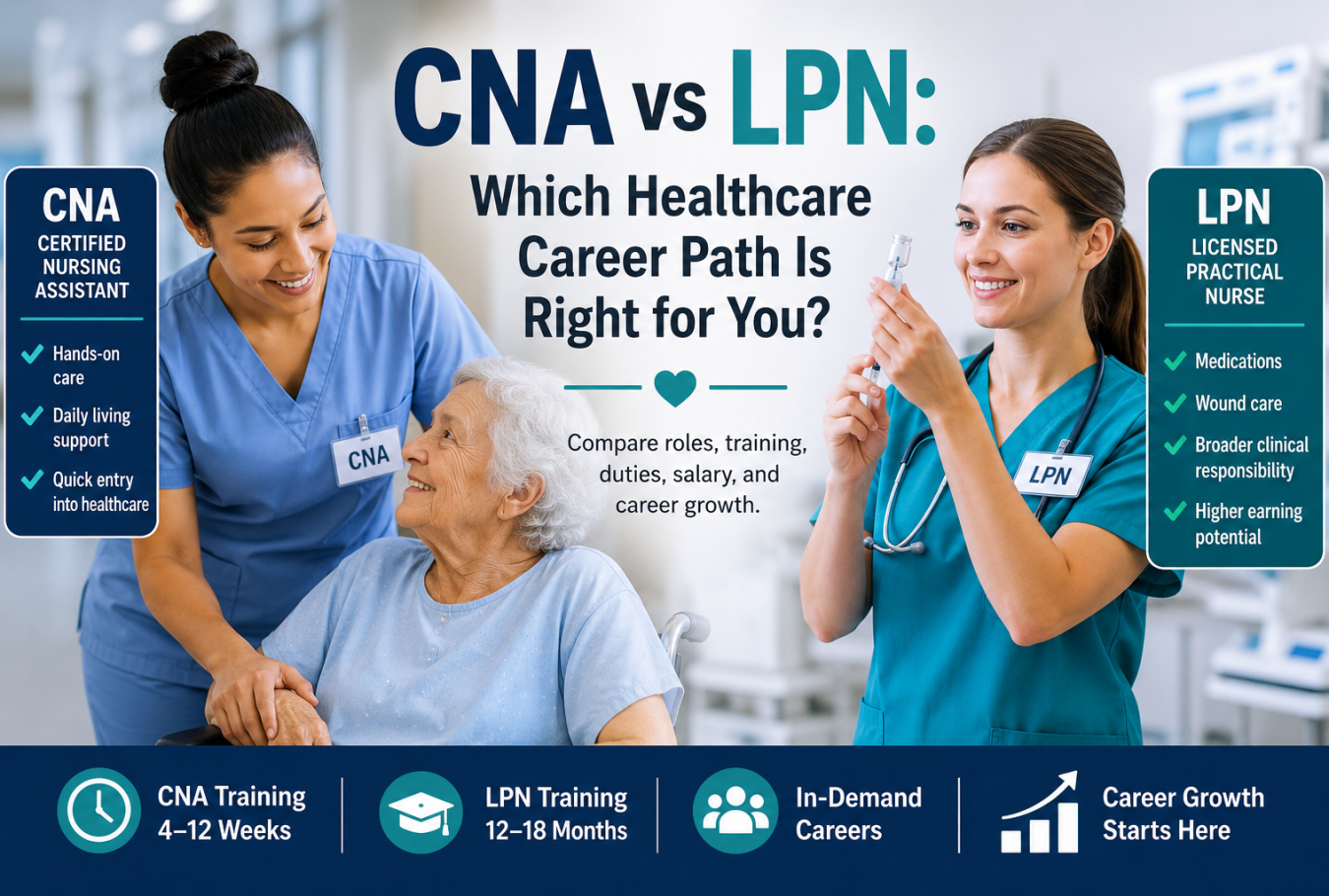
A CNA, or certified nursing assistant, provides hands-on personal care and basic clinical support under the supervision of licensed nurses. An LPN, or licensed practical nurse, has a broader nursing role that may include medication administration, wound care, patient monitoring, and other clinical tasks allowed by state law.
The main difference is scope. CNAs help patients with daily care and basic support. LPNs provide more clinical nursing care and must complete a longer formal nursing program and pass the NCLEX-PN licensing exam.
If you want to enter healthcare quickly, CNA may be the better first step. If you are ready for a longer education path and want more responsibility, LPN may be the stronger fit.
A CNA can usually start working after completing a state-approved CNA training program, which often takes several weeks , learn more about how long CNA training takes followed by a state competency exam.
| Role | Best For | Training Path | Main Responsibility |
|---|---|---|---|
| CNA | Fast entry into healthcare | State-approved CNA training + exam | Daily care and basic support |
| LPN | Broader nursing responsibility | Practical nursing program + NCLEX-PN | Basic nursing care and clinical tasks |
Many people start as a CNA, gain patient care experience, then move into an LPN, RN, or other nursing pathway.
A CNA provides direct patient care and helps patients with everyday needs. CNAs often spend more time with patients than many other members of the care team, especially in long-term care and nursing home settings.
Common CNA duties include:
A CNA does not work independently. CNAs work under the supervision of an RN, LPN, or other licensed nurse depending on the setting.
An LPN provides basic nursing care under the supervision of an RN, physician, or other approved healthcare provider. LPN duties vary by state, facility, and employer policy.
Common LPN duties may include:
Some states allow LPNs to perform IV therapy or additional clinical tasks after specific training. Other states limit those duties. Scope of practice is state-specific, so learners should always check their state board of nursing.
| Category | CNA | LPN |
|---|---|---|
| Full title | Certified Nursing Assistant | Licensed Practical Nurse / Licensed Vocational Nurse |
| Role type | Entry-level direct care | Licensed nursing role |
| Training length | Often several weeks | Often about 12 months |
| Exam | State CNA competency exam | NCLEX-PN |
| License or certification | State CNA certification/registry | State nursing license |
| Medical tasks | Limited basic support | Broader clinical care |
| Medication administration | Usually no | Usually yes, within state scope |
| Wound care | Limited support under supervision | Often yes, within state scope |
| Works under | RN or LPN supervision | RN, physician, or approved provider |
| Common settings | Nursing homes, hospitals, assisted living, home care | Nursing homes, clinics, hospitals, home health |
| Career use | Entry point into healthcare | Practical nursing career or bridge to RN |
Which Path Is Faster?
CNA is usually the faster path. Many CNA programs can be completed in weeks, while LPN programs usually require about a year of formal practical nursing education.
Choose CNA if you want to:
Choose LPN if you are ready to:
LPNs have more clinical responsibility than CNAs. CNAs focus mainly on direct care, comfort, hygiene, mobility, and reporting. LPNs can perform nursing tasks such as medication administration and wound care where allowed by state law.
A simple way to understand it:
This does not mean CNA work is less important. In many care settings, CNAs are the first to notice changes in a patient’s condition because they spend so much time with patients.
LPNs usually earn more than CNAs because they complete more education, hold a nursing license, and have a broader clinical scope.
According to BLS data, the median annual wage for nursing assistants was $39,530 in May 2024. The median annual wage for licensed practical and licensed vocational nurses was $62,340 in May 2024. Actual pay varies by state, employer, shift type, setting, experience, and local demand.
Pay may be higher in:
Do not choose only based on salary. LPN takes more time, tuition, responsibility, and licensing requirements. CNA may be the better first step if you are still exploring healthcare.
Yes, CNA can be a strong first step before LPN because it gives you real patient care experience before committing to nursing school.
Starting as a CNA can help you learn:
Some future LPNs benefit from working as a CNA because they enter nursing school with more confidence around patients, facilities, documentation, and care routines.
However, CNA experience does not replace LPN education. To become an LPN, you still need to complete an approved practical nursing program and pass the NCLEX-PN.
CNA is usually the better choice if you want a quicker, lower-barrier entry into healthcare.
Choose CNA if:
CNA is also a practical option for people who want to build confidence before committing to LPN or RN training.
LPN is usually the better choice if you already know you want a licensed nursing role and are ready for more responsibility.
Choose LPN if:
LPN can be a good middle step between CNA and RN for learners who want a practical nursing career without immediately committing to a full RN program.
No. An LPN has a broader scope of practice and must complete a practical nursing program and pass the NCLEX-PN. CNAs provide essential direct care but work under licensed nurse supervision.
Yes. Many CNAs later become LPNs. CNA experience can help with confidence and patient care skills, but you still need to complete an approved LPN program and pass the NCLEX-PN.
Generally, no. LPN licensure requires completion of an approved practical nursing program. CNA experience alone does not replace that requirement.
Usually, yes. LPN programs are longer and cover more clinical topics, including nursing fundamentals, pharmacology, patient assessment, medication administration, and practical nursing care.
In many settings, yes. LPNs may supervise or direct CNA work depending on the facility, state rules, and employer policy.
Yes. LPN and LVN refer to the same practical nursing role. California and Texas use the title LVN, while most other states use LPN.
t can be a smart move if you want hands-on patient care experience before entering LPN or RN training. It is not always required, but it can help you understand healthcare work before making a bigger commitment. Start with our guide on how to become a CNA, or if timing is your main concern, read how long it takes to become a CNA online.
A career as a home health aide offers steady employment, genuine purpose, and a clear entry point into the broader healthcare field. With online training through NCOOA, you can earn your certification on your own schedule.