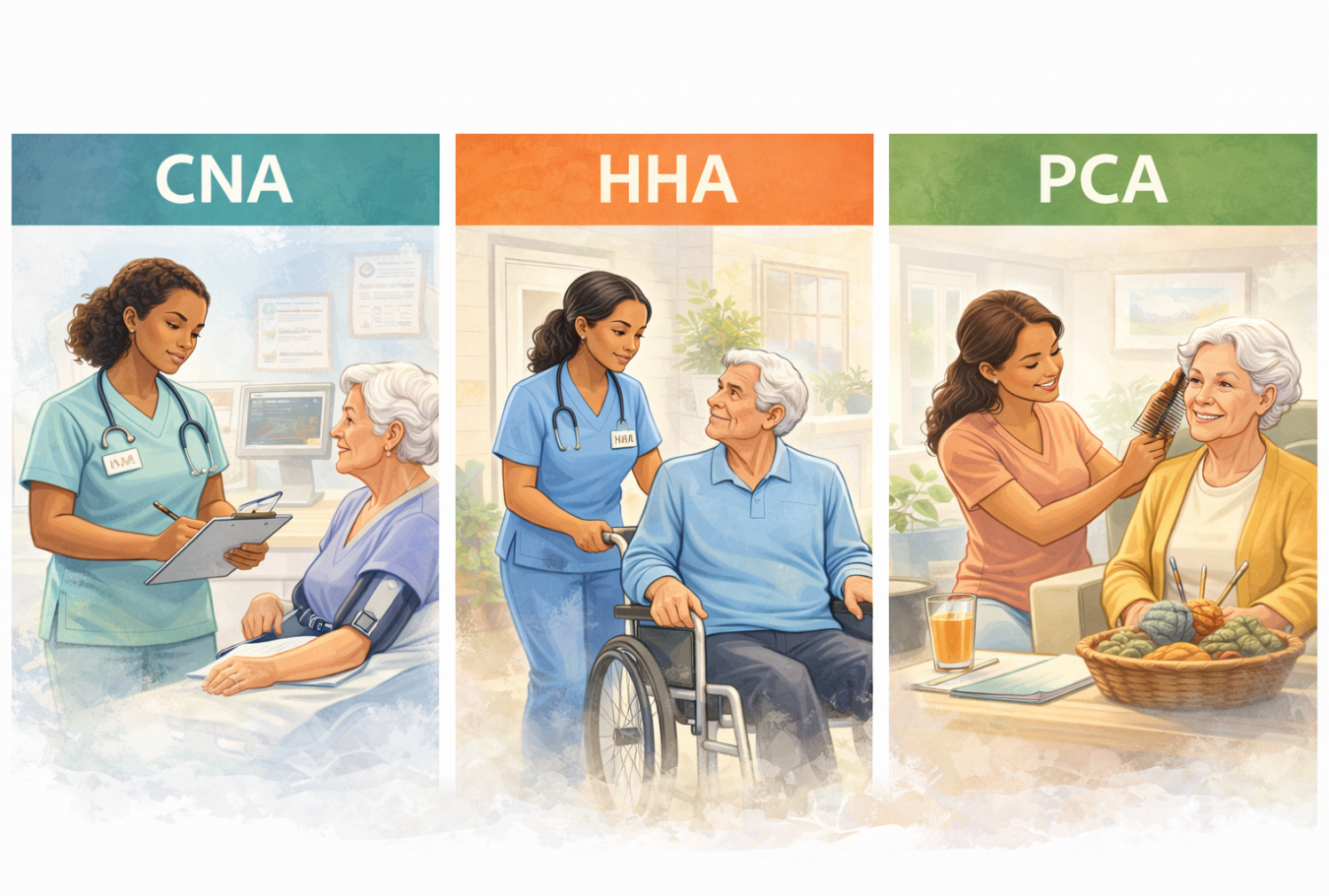
If you are thinking about starting a career in caregiving, you have probably come across three common titles: CNA, HHA, and PCA. They sound similar, but they are quite different when it comes to job duties, training requirements, work settings, and where your career can go.
This guide gives you a plain-English breakdown of all three roles so you can choose the path that fits your goals. You can also browse NCOOA’s full range of online caregiver courses to see which programs are available right now.
Quick answer:
A CNA (Certified Nursing Assistant) works in clinical settings like hospitals and nursing homes, carries the broadest clinical responsibilities, and must pass a state exam. An HHA (Home Health Aide) provides personal care and basic health services in a client’s home and typically needs state-approved training. A PCA (Personal Care Aide) offers non-medical support at home and has the most flexible entry requirements. CNAs earn the most; PCAs have the fastest entry path.
A CNA, or Certified Nursing Assistant, is a trained healthcare worker who provides basic patient care under the direct supervision of a licensed nurse. CNAs typically work in nursing homes, hospitals, rehabilitation centers, and long-term care facilities.
To become a CNA, you must complete a state-approved training program and pass a two-part competency exam: a written knowledge test and a hands-on skills evaluation. Training programs range from 75 to 150 hours depending on the state. It is the most credential-intensive of the three roles, but it opens the door to higher pay and more formal healthcare settings.
NCOOA offers an online CNA exam prep course with 12 months of self-paced access to help you prepare for the state exam at your own pace.
A Home Health Aide provides personal care and basic health-related services to clients in their own homes. HHAs often work with elderly clients, people recovering from surgery, or individuals with disabilities who prefer to stay at home rather than move into a facility.
Most states require HHAs to complete a state-approved training program and pass a competency evaluation before working for a Medicare-certified agency. Federal requirements set a minimum of 75 training hours. NCOOA’s online HHA certification course covers all required competencies and is fully self-paced with 12 months of access.
A Personal Care Aide, sometimes called a Personal Care Worker or Private Duty Caregiver, provides non-medical support to clients at home. PCAs focus on helping with activities of daily living and do not perform clinical tasks.
Unlike CNAs and HHAs, PCAs working in private-pay or independent arrangements are not always required to hold a state license or pass a state exam. That makes the PCA path the fastest way into professional caregiving. Many families hire PCAs directly without going through an agency. NCOOA offers a personal care assistant online course and a personal care worker course for those who want a recognized credential to strengthen their job applications.
Use this table to see how all three roles compare at a glance across the most important factors.
| CNA | HHA | PCA | |
|---|---|---|---|
| Full title | Certified Nursing Assistant | Home Health Aide | Personal Care Aide |
| Work setting | Hospital, nursing home, clinic | Client’s home, assisted living | Client’s home, group home |
| Clinical tasks | Yes | Limited (under supervision) | No |
| State exam required | Yes | Often yes | Usually no |
| Min. training hours | 75–150 hrs | 75 hrs | 40–75 hrs |
| Avg. hourly pay | $16–$20/hr | $14–$18/hr | $12–$16/hr |
| Career advancement | LPN, RN bridge programs | CNA, LPN pathway | HHA, CNA pathway |
| Best for | Clinical healthcare settings | One-on-one home care | Flexible entry into caregiving |
Pay varies by role, location, employer, and experience. The ranges below reflect national averages based on U.S. Bureau of Labor Statistics data. For a full breakdown by state, see our caregiver salary guide for 2026.
CNA: $16–$20/hr average | $33,000–$42,000/yr | Highest of the three roles
HHA: $14–$18/hr average | $29,000–$37,000/yr | Mid-range, depends on agency and state
PCA: $12–$16/hr average | $25,000–$33,000/yr | Widest variance; private-duty rates can exceed $20/hr in major cities
CNAs earn the most across the board because they work in regulated settings, carry clinical responsibilities, and must pass a licensing exam. Private-duty PCAs in major metro areas can earn well above the national average when working directly with families.
All three roles serve as solid entry points into healthcare, and each one has a clear ladder for those who want to advance.
CNAs are well-positioned to advance into Licensed Practical Nursing (LPN) or pursue an RN through a bridge program. Many healthcare employers offer tuition reimbursement specifically for CNAs advancing to nursing roles. See our article: becoming a CNA in today’s medical landscape.
HHAs can expand their scope by completing a direct care worker course or pursuing CNA certification to move into facility-based roles with higher pay. Many HHAs build long careers in home care by developing trusted relationships with repeat clients and agencies.
PCAs looking to advance typically pursue HHA or CNA credentials next. NCOOA’s online programs make it straightforward to build on existing experience and move into higher-paying, more regulated roles without pausing your current work.
Your ideal starting point depends on where you want to work, how quickly you need to enter the workforce, and what your longer-term career goals look like.
| Your goal | Best starting path |
|---|---|
| Work in a hospital or nursing home | CNA: complete state-approved training and pass the competency exam |
| Care for clients one-on-one in their homes | HHA: complete state-approved training, eligible for agency and Medicaid-funded work |
| Get into caregiving quickly with flexible entry | PCA: shorter training, ideal for private-pay and family care arrangements |
| Move toward licensed nursing (LPN or RN) | CNA: the most direct credential ladder into clinical nursing roles |
| Work with elderly clients who want to stay home | HHA or PCA: both roles focus on home-based care and daily living support |
If you are still deciding, visit our frequently asked questions page for more detail, or browse all available caregiver training programs to compare what is included in each course.
National Caregiver Organization of America offers fully online, self-paced training programs for all three roles. Every course is designed to be beginner-friendly, affordable, and accessible to anyone regardless of prior experience or educational background.
All courses include 12 months of access from the day you enroll, so you can study whenever your schedule allows. There are no prerequisites and no fixed class times.
A CNA works in regulated healthcare settings like hospitals and nursing homes, performs clinical tasks, and must pass a state licensing exam. An HHA works in a client’s home, provides personal care and basic health services, and typically needs state-approved training to work for a Medicare-certified agency. CNAs generally earn more and have a broader clinical scope.
No. A PCA (Personal Care Aide) provides non-medical support only, such as help with bathing, dressing, meal prep, and companionship. An HHA can perform limited clinical tasks like checking vital signs under a nurse’s direction and is generally subject to more formal training and licensing requirements than a PCA.
PCA training is typically the shortest, ranging from 40 to 75 hours depending on the program and state. HHA training generally requires around 75 hours at minimum. CNA programs range from 75 to 150 hours and also require passing a state exam. NCOOA’s online courses are self-paced, so completion time depends on how much time you can commit each week. See: how long does it take to become a CNA online?
Yes. Many PCAs use their caregiving experience as a foundation and go on to complete HHA or CNA training. Your hands-on experience with clients will give you a practical head start in any certification program you pursue next.
It depends on the role and the employer. CNAs and HHAs working for Medicare or Medicaid-certified agencies must be formally trained and certified. PCAs in private-pay arrangements often do not. For a full breakdown, read: can you be a caregiver without certification?
Nationally, CNAs earn $16–$20/hr on average, HHAs earn $14–$18/hr, and PCAs earn $12–$16/hr. These ranges vary by state, employer, experience, and work setting. For a full salary breakdown, see our caregiver salary guide for 2026.
A career as a home health aide offers steady employment, genuine purpose, and a clear entry point into the broader healthcare field. With online training through NCOOA, you can earn your certification on your own schedule.