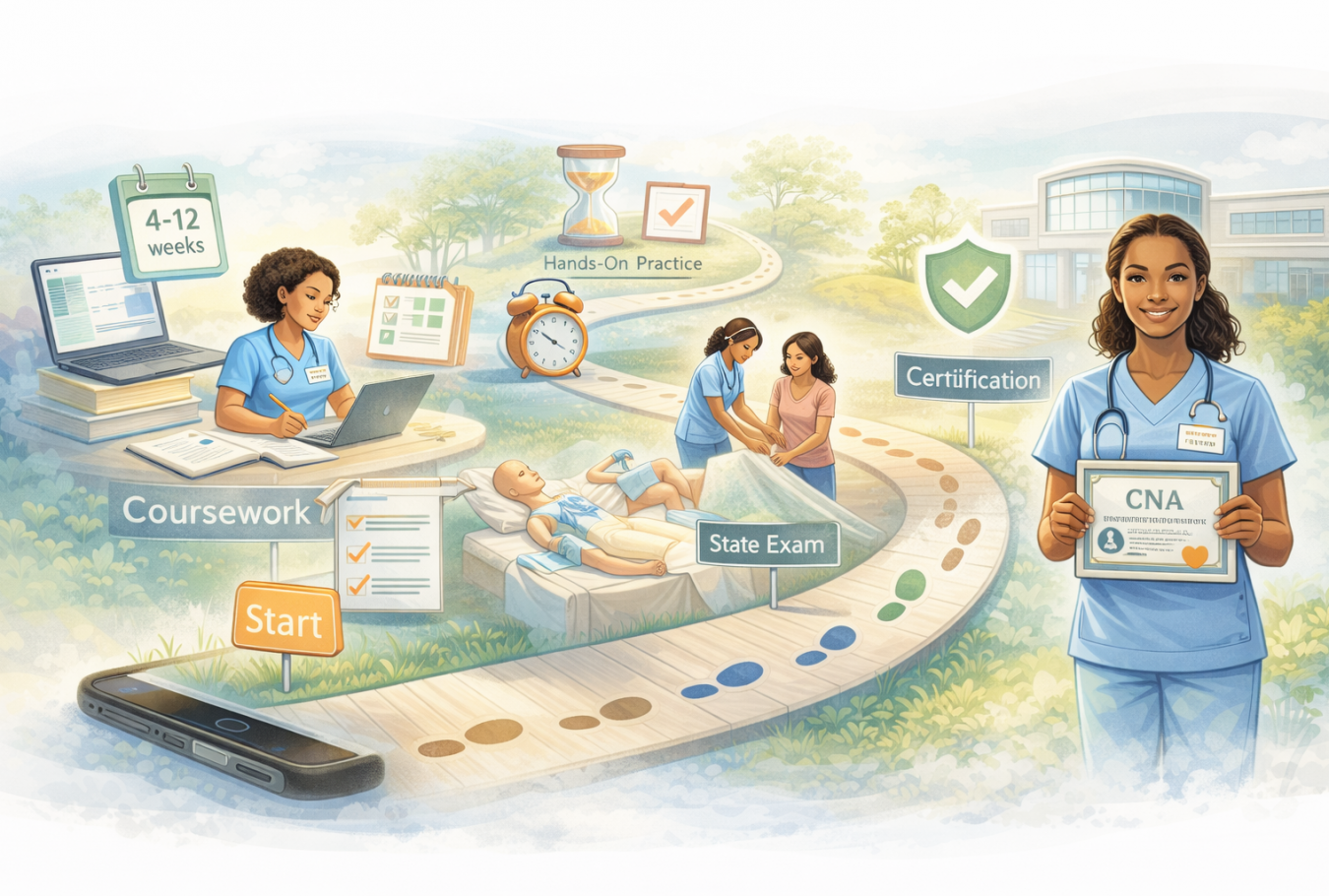
One of the most common questions from people thinking about a caregiving career is: how long does CNA training actually take? The answer depends on three things: your state’s hour requirements, whether you study full-time or part-time, and whether you choose an in-person or online program.
This guide breaks it all down clearly so you can plan your path to CNA certification with realistic expectations. If you’re still deciding which credential is right for you, our nursing courses overview compares all available programs.
The short answer
Most people finish a CNA training program in 4 to 12 weeks when studying full time. Part-time learners usually take 3 to 6 months. Online CNA prep courses, like the one offered at National Caregiver Organization, are self-paced, meaning you move as fast or as slow as your life allows.
The federal government, through the Centers for Medicare & Medicaid Services (CMS), requires at least 75 hours of CNA training before a student can sit for the state certification exam. However, many states exceed this minimum. Always verify your state’s exact requirements with your State Nurse Aide Registry before enrolling.
| State | Minimum training hours | Notes |
|---|---|---|
| California | 150 hours | One of the highest in the US |
| Florida | 120 hours | Includes clinical component |
| State | Minimum training hours | Notes |
|---|---|---|
| Texas | 100 hours | 16 hours clinical skills |
| New York | 100 hours | Includes 30 hours supervised practical |
| Illinois | 80 hours | Meets federal minimum + state add-on |
| Federal minimum | 75 hours | Required by CMS for all states |
Important: These figures are subject to change. Always confirm your state’s current hour requirements directly with your State Nurse Aide Registry before enrolling in any CNA training program.
A complete CNA training program teaches both the knowledge and hands-on skills you need to work safely and effectively in a clinical setting. NCOOA’s online CNA prep course covers approximately 150 hours of structured content, available 24/7, with situational lessons, quizzes, and guided practice scenarios.
CNA programs also teach the 21 essential nursing skills that are tested during the hands-on portion of the state certification exam. These include:
NCOOA course note: NCOOA’s CNA prep course includes over 150 hours of structured content with 12 months of access from the day you enroll. Study at any time. There are no set class schedules.
Here is the full process from enrollment to earning your CNA credential:
The training portion, including all coursework, knowledge prep, and skills practice, can be completed 100% online. This is where NCOOA’s self-paced CNA prep course comes in.
However, two components cannot be done remotely:
Some states also require a minimum number of in-person clinical hours before you can sit for the exam. Check your state board’s requirements to confirm.
The skills evaluation portion of the state exam is conducted in person at an approved testing center.
Bottom line: You can complete all of your studying, preparation, and knowledge training online. Only the final skills demonstration requires an in-person visit. This makes online CNA prep a genuinely flexible path for working adults.
Use this table to estimate how long your CNA journey will take based on your study schedule and program type.
| Study path | Estimated time to certification | Best for |
|---|---|---|
| Full-time online study | 4–8 weeks | Career changers, motivated self-starters |
| Part-time online study | 3–6 months | Working adults, parents, busy schedules |
| In-person or hybrid program | 6–12 weeks | Learners who prefer classroom structure |
Online CNA training typically takes 4–8 weeks for full-time students and 3–6 months for part-time learners. The exact length also depends on your state’s minimum hour requirements, which range from 75 to 150+ hours. NCOOA’s self-paced online course gives you 12 months of access, so you set your own pace.
The fastest path is to enroll in a self-paced online CNA prep program, dedicate consistent study time each day, and register for your state exam as soon as you complete your required hours. Some students complete the coursework portion in as little as 3–4 weeks. Visit our CNA prep course to get started.
It depends on your state. The federal minimum of 75 training hours must include a hands-on clinical component, but the delivery of that clinical training varies by state and program. Some states accept simulation-based skills practice as part of online programs; others require in-person supervised hours. Check your State Nurse Aide Registry for the specific rules in your area.
In most states, CNA certifications are valid for 24 months. To maintain your active status on the State Nurse Aide Registry, you must work as a paid CNA during that period and complete any required continuing education before renewing.
Once you pass both the written and skills portions of your state’s CNA competency exam, your name is added to the State Nurse Aide Registry and you can legally work as a Certified Nursing Assistant. From there, many CNAs go on to pursue further credentials, including home health aide (HHA) certification or LPN programs.
A CNA (Certified Nursing Assistant) typically works in hospitals, nursing homes, or clinical settings and must pass a state exam. An HHA (Home Health Aide) primarily works in clients’ homes and has somewhat different training requirements. For a full comparison, read: CNA vs HHA vs PCA: what’s the difference?
A career as a home health aide offers steady employment, genuine purpose, and a clear entry point into the broader healthcare field. With online training through NCOOA, you can earn your certification on your own schedule.