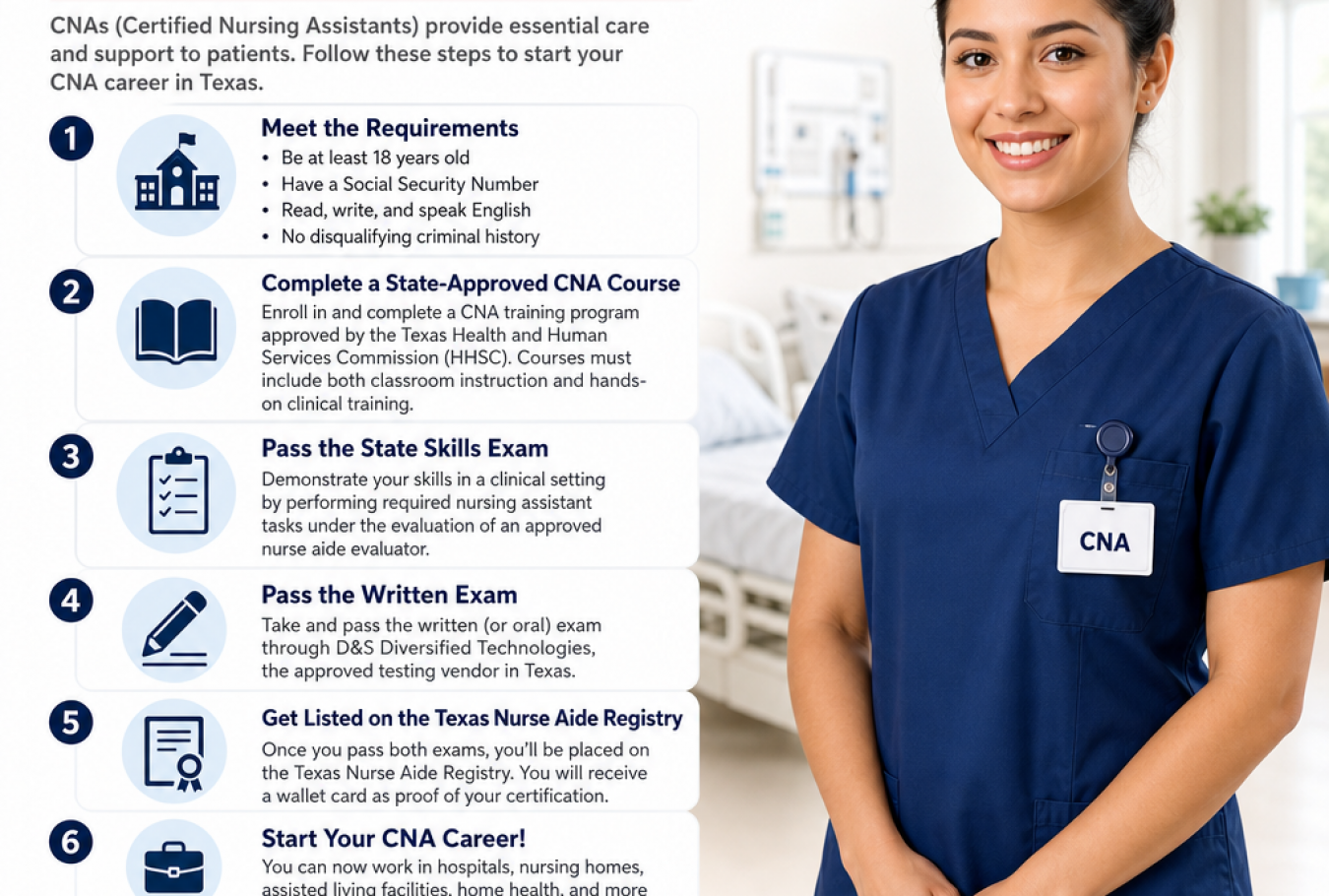
Texas is one of the largest healthcare markets in the United States, and certified nursing assistants are at the heart of daily patient care from Houston and Dallas to San Antonio and Austin. If you’re looking for a meaningful healthcare career with a clear pathway to get started, becoming a CNA in Texas is an excellent choice.
This guide covers every step of the process — from completing your training to passing the state exam and getting listed on the Texas Nurse Aide Registry.
Certified nursing assistants in Texas work in skilled nursing facilities, hospitals, long-term care communities, home health agencies, and assisted living settings. Core duties include helping patients with bathing, grooming, dressing, eating, and mobility, as well as measuring vital signs and reporting patient status to supervising nurses.
Texas has a large and growing elderly population, meaning the demand for trained, compassionate CNAs continues to rise throughout the state.
The Texas Department of Aging and Disability Services (DADS), now part of the Health and Human Services Commission (HHSC), regulates CNA training and certification in Texas.
Age: Most programs require applicants to be at least 18. Some exceptions apply for high school students in vocational programs.
Background check: A criminal history check is required. Texas law prohibits individuals with certain convictions from working in nursing facilities or home health agencies.
Health requirements: Many programs and employers require a physical exam, TB screening, and proof of immunizations before clinical training begins.
Texas requires completion of a state-approved CNA training program. Programs must include a minimum of 100 hours of combined classroom and clinical training. Many programs exceed this minimum.
Training is available through community colleges, hospitals, vocational schools, and some long-term care facilities. Costs and schedules vary by provider.
Before and during your training, NCOOA’s CNA exam prep course provides a flexible way to study the core knowledge areas covered in the Texas CNA competency exam. It is self-paced and available in over 100 languages.
The Texas CNA competency exam is administered by Pearson VUE on behalf of the Texas HHSC. The exam has two components:
Both parts must be passed to receive your certification. If you fail one section, you may retake only that section within your eligibility window.
After passing your exam, your name is added to the Texas Nurse Aide Registry. Texas employers are required to verify that nursing assistants appear on the registry before hiring them in covered facilities.
You can look up your CNA license number through the Texas Nurse Aide Registry online portal.
Texas CNA certifications must be renewed every two years. Active employment in a nursing assistant role during the renewal period is required. Requirements can change, so confirm renewal procedures directly with the Texas HHSC.
Texas requires at least 100 hours of approved CNA training, including a minimum of 16 hours of supervised clinical experience. Full-time programs typically run four to eight weeks. Part-time formats may extend the timeline to three months or more.
Preparation resources like NCOOA’s online nursing courses allow you to study foundational concepts at your own pace alongside your formal training program.
If you hold an active CNA certification in another state, you may be able to transfer your credential to Texas through a reciprocity process. You will typically need to submit an application, verification of your out-of-state certification, and pass any additional Texas requirements that may apply.
Contact the Texas Nurse Aide Registry directly to confirm the steps for reciprocity and whether your current certification qualifies.
CNA wages in Texas vary based on location, setting, and experience. On average, CNAs in Texas earn between $13 and $18 per hour.
Metropolitan areas like Houston, Dallas, Austin, and San Antonio tend to offer higher compensation than smaller cities or rural areas. Specialty settings, including hospitals and rehabilitation centers, often pay more than general long-term care.
Many Texas CNAs pursue advanced healthcare roles over time, using their nursing assistant experience as a foundation for LVN or RN programs.
The National Caregiver Organization of America provides accessible, self-paced training resources for aspiring caregivers and nursing assistants. NCOOA’s CNA exam prep course is built to help you review the knowledge areas tested by state competency exams, so you feel confident and prepared.
NCOOA courses are available in over 100 languages, making professional development accessible across Texas’s multilingual communities.
Visit our FAQ page to learn more about our programs and get answers to common caregiver training questions.
A career as a home health aide offers steady employment, genuine purpose, and a clear entry point into the broader healthcare field. With online training through NCOOA, you can earn your certification on your own schedule.