
80+ hrs
Of private caregiving education
Self-paced instruction covering every essential private caregiver skill — complete on your schedule, at your own speed.
Begin your caregiving journey with the Personal Care Worker (PCW) Online Course from The National Caregiver Organization. Learn how to provide essential daily living assistance, promote independence, and offer compassionate care to those in need. Enroll today to start a flexible, rewarding career dedicated to improving the lives of others.
Course overview
Built around the full spectrum of private caregiving competencies — from personal care and safety to communication, nutrition, and compassionate support.
80+ hrs
Self-paced instruction covering every essential private caregiver skill — complete on your schedule, at your own speed.
127+
Video lessons and skill demonstrations across every PCW competency — plus 5 knowledge quizzes with unlimited retakes.
100%
From any phone, tablet, or laptop — no classroom, no commute. Available in over 100 languages.
The PCW role
A private caregiver worker provides compassionate, non-medical support directly for private clients and their families — helping elderly, disabled, or recovering individuals maintain safety, independence, and quality of life in their own homes. PCWs are hired personally by families who value flexibility, privacy, and a trusted one-on-one caregiving relationship.
What is private-pay home care?
Private-pay home care refers to caregiving services paid for directly by the client or their family — not billed through Medicare, Medicaid, or insurance. Families who hire private caregivers directly often gain more flexibility in scheduling, caregiver selection, and the scope of services provided. The PCW credential signals to families that their caregiver has completed formal, professional training.
Meaningful conversation, activities, outings, and emotional presence — the heart of private companion caregiving.
Bathing, grooming, oral care, dressing, and all daily personal hygiene tasks — performed with dignity and respect.
Grocery shopping, laundry, meal prep, and light cleaning — keeping the client's home safe and comfortable.
Safe repositioning, transfers, fall prevention, and assistive device support for clients with mobility limitations.
Preparing nutritious, tailored meals and snacks, monitoring hydration, and supporting special dietary needs.
Measuring blood pressure, pulse, temperature, and respirations to monitor health and report changes promptly.
Identifying hazards, preparing for emergencies, and creating a safe home environment for vulnerable clients.
Clear, professional communication with clients, families, and care managers — building trust and long-term relationships.
PCW care is non-medical. Private caregiver workers provide hands-on personal care and companionship support — they do not diagnose conditions, prescribe treatments, or perform clinical nursing procedures. This makes the role highly accessible for people without a medical background, and highly valued by private clients seeking personal, dignified care.
Three powerful reasons to enroll
Whether you want to work independently for private clients, build a companion care practice, or care for a family member — the PCW Online Course gives you the professional credential for just $64.99.
Private families across the US hire caregivers directly — bypassing agencies to get more flexible, personalized care. Your PCW certificate is the professional credential they look for when searching for a private caregiver they can trust.
Millions of elderly Americans need regular companionship, light assistance, and daily check-ins — not full nursing care. The PCW credential formalizes your role as a trusted private companion caregiver, giving families peace of mind when they hire you.
Caring for an aging parent or disabled relative? The PCW certificate documents your training formally — useful for care plans, family communication, and some private-pay family caregiver arrangements outside of Medicaid frameworks.
Who it's for
From people entering the private care market for the first time to experienced caregivers formalizing their skills — the PCW Online Course meets you wherever you are.
Already providing private care to clients directly? The PCW certificate formalizes your expertise and gives families the credential they're looking for.
Providing non-medical companionship and light assistance? The PCW credential positions you professionally in the growing private companion care market.
Caring for a parent, spouse, or relative at home? A PCW certificate documents your training and skill level formally for care plans or family discussions.
No experience needed. The PCW credential is a respected entry point into private home care — advance from here to HHA, CNA, and beyond.
Transitioning from another field? Private home care offers meaningful work, a flexible schedule, and strong demand — with the PCW as your starting credential.
Building your own independent caregiving practice? The PCW certificate is the professional foundation that distinguishes you from uncredentialed private caregivers.
Course syllabus
The curriculum covers every private caregiving skill — from infection control and household safety to client communication, nutrition, mental health awareness, and end of life care.
15
Topics
127
Lessons
5
Quizzes
80%
Min. passing grade
How it works
Entirely online, self-paced, and accessible 24/7 — no classroom, no commute, no set schedule.
Register via secure PayPal checkout. Get instant access to all 127 lessons, quizzes, and free CPR training.
Study all 15 topics at your own pace — 24/7, from any device. One full year of access from enrollment.
Score 80% or higher. Unlimited retakes included — study, retry, and pass at your own pace.
Your PCW Certificate of Completion is emailed within 3 to 5 business days — ready to share with private clients and families.
The private caregiver opportunity
The private home care market is one of the fastest-growing segments of the US care economy. As the population ages, more families are choosing to hire caregivers directly — rather than through agencies — for more flexible, personal, and often more affordable care. For caregivers, working privately means no agency commissions, no rigid schedules, and the freedom to build lasting one-on-one relationships with clients.
Private-pay caregivers with a professional credential — like the PCW certificate — are better positioned to attract and retain private clients, command higher rates, and build a sustainable independent caregiving practice.
$18–25
Typical private-pay hourly rate
20%+
Projected job growth through 2032
$64.99
One-time course investment
No agency commissions — keep your full rate
Earning potentialAgency caregivers typically earn $13–$16/hr while the agency charges families $25–$35/hr. As a private caregiver, you negotiate directly with the family and keep what you earn — no middleman, no commission split.
What families look for when hiring a private caregiver
Client trustFamilies searching for a private caregiver for an elderly parent want proof of training, not just a good reference. A PCW Certificate of Completion is the formal credential that demonstrates you have completed professional caregiver education — building immediate trust and confidence.
Flexible scheduling — work on your own terms
IndependencePrivate caregivers set their own schedules, choose their clients, and define their service areas. Whether you prefer mornings, evenings, live-in care, or hourly visits — you are in control of your caregiving practice.
| Caregiver type | Typical hourly pay | Sets own rates? |
|---|---|---|
| Private caregiver (PCW) | $18–$25/hr | Yes |
| Agency caregiver (HHA) | $13–$16/hr | No |
Pay rates are estimates based on market data. Actual rates vary by location, client, and experience. Always verify local market rates independently.
PCW vs PCA vs DCW vs HHA
All four credentials involve caregiving — but they serve different markets and carry different credential names. Here's how the PCW stands apart.
| PCW — Private Caregiver Worker | PCA — Personal Care Asst. | DCW — Direct Care Worker | HHA — Home Health Aide | |
|---|---|---|---|---|
| Primary market | Private-pay clients & families | Medicaid/CDPAP programs | Broad direct care & entrepreneurship | Home health agencies & private |
| Work setting | Private home · independent | Private home · Medicaid programs | Home or community | Client's home (agency or private) |
| Agency required? | No — fully independent | No — private or Medicaid | No — independent or business | Optional — agency or private |
| Best for | Private-pay & companion care | Medicaid family caregiving | Family care & home care business | Broader home health scope |
| State exam required | No | Generally no | Generally no | At Medicare agencies only |
| NCOOA price | $64.99 | $64.99 | $64.99 | $99.99 |
| Enroll | Enroll now — $64.99 | View PCA course | View DCW course | View HHA course |
All NCOOA courses share the same curriculum and include free CPR + First Aid training. Not sure which course is right? Browse all courses or visit our FAQ.
Pay & career advancement
Private caregiving offers strong earning potential for those who build their own client base — and a clear ladder for those who want to advance toward clinical credentials.
Typical private caregiver hourly pay (US)
$18–$25
per hour for private-pay arrangements
Private-pay rates are set independently between caregiver and client. Agency caregivers typically earn $13–$16/hr. Rates vary by location, services provided, and experience. Always verify local market rates.
20%+
Projected personal care aide job growth through 2032 (BLS). Private-pay demand growing faster than agency-based roles.
| Role | Next step | Avg. pay |
|---|---|---|
| PCW ← Start here | PCW Online Course ($64.99) | $18–$25/hr private |
| PCA | PCA Online Course ($64.99) | $13–$17/hr |
| HHA | HHA Online Course ($99.99) | $14–$18/hr |
| CNA | CNA Exam Prep + state exam | $16–$20/hr |
| LPN | 12–18 mo. program + NCLEX-PN | $24–$32/hr |
| RN | LPN→RN bridge + NCLEX-RN | $35–$50+/hr |
Why NCOOA
Everything you need to build private caregiving skills and earn your PCW certificate — no classroom, no experience required, no hidden costs.
The PCW certificate is the recognized credential private families look for when hiring an independent caregiver.
One payment, full access, no subscriptions. The most affordable path to a professional private caregiver certificate.
No deadlines. One full year from enrollment to revisit lessons and retake quizzes at your own pace.
Retake every quiz and the final exam as many times as needed — no penalty, no extra cost.
Phone, tablet, or laptop — any time of day, anywhere in the US. No downloads required.
Built for complete beginners — no medical background, no prerequisites, no healthcare experience needed.
Free CPR training and Basic First Aid training included — noted on your certificate of completion.
Pass the final exam and your PCW Certificate of Completion is emailed within 3 to 5 business days.
Questions? Contact us
Or visit our FAQ page ·
Available in
100+ languages
Click the grey box in the bottom right corner of the website to select your preferred language.
PCW course — frequently asked questions
Answers about the course, what private caregiver workers do, how the private care market works, what PCWs earn, and how the PCW compares to HHA, PCA, and DCW credentials.
NCOOA's Private Caregiver Worker Online Course includes 80 hours of self-paced instruction across 15 topics and 127 lessons. The curriculum covers every competency needed to provide professional private caregiving, including infection control, household safety, nutrition, body systems, client communication, vital signs, hygiene, assisting disabled clients, mental health awareness, and end of life care.
Also included at no extra cost: free CPR training and free Basic First Aid training. You receive one full year of access, unlimited test retakes, and a minimum passing grade of 80%.
The Private Caregiver Worker Online Course is a one-time payment of $64.99 — that includes all 127 lessons, all quizzes, free CPR training, free Basic First Aid training, and one full year of access. No subscriptions, no hidden fees, and no additional purchases required.
The PCW Online Course includes 80 hours of instruction and is entirely self-paced — you study at whatever speed works for you. With consistent daily study, most students complete the course within a few weeks. You have one full year of access from enrollment, so there is no rush or pressure to finish quickly.
Yes. Upon passing the final exam with a minimum score of 80%, you receive a Private Caregiver Worker Certificate of Completion from National Caregiver Organization of America, emailed within 3 to 5 business days. Your free CPR and Basic First Aid training completion is noted on the same certificate. Unlimited retakes are included — no penalty for retrying.
Yes. The NCOOA website and all course content are available in over 100 languages. Click the grey box in the bottom right corner of the website to select your preferred language. This makes professional private caregiver training accessible to diverse learners across the United States.
A private caregiver worker (PCW) provides compassionate, non-medical personal care and companionship to elderly, disabled, or recovering clients — directly for private families without requiring an agency intermediary. The core of private caregiving is building trusted, one-on-one relationships with clients over time.
Typical PCW duties include:
There is significant overlap. A companion caregiver typically focuses on social interaction, light assistance, and companionship — without hands-on personal care tasks like bathing or hygiene. A PCW (Private Caregiver Worker) can provide both companion care and personal care support, making the credential more comprehensive and versatile. The PCW course covers the full range of private caregiving competencies, including both companion and personal care duties.
Private-pay home care refers to caregiving services paid for directly by clients or families — not billed through Medicare, Medicaid, or insurance. Families who hire private caregivers gain more control over scheduling, caregiver selection, and the scope of care. This is one of the fastest-growing segments of the US home care market.
The PCW credential matters for private-pay caregiving because:
Yes — many caregivers work independently for private clients without being employed by an agency. Private caregivers set their own hours, negotiate their own rates, choose their clients, and keep their full earnings without agency commissions. State regulations around independent caregiving vary, so it is advisable to verify local requirements for self-employed caregivers in your state. A PCW certificate is the professional credential you present to private clients and families as evidence of your training.
When families search for a private caregiver for an elderly parent or family member, they typically look for a combination of trustworthiness, compassion, and formal training. The most important factors include:
Your PCW Certificate of Completion from NCOOA satisfies the training credential requirement and signals to families that you have completed professional caregiver education.
Private-pay caregivers typically earn $18–$25 per hour — significantly more than the $13–$16/hr that agency-employed caregivers usually receive. Because private caregivers negotiate their rates directly with families, pay depends on location, experience, the scope of care provided, and local market demand. In high cost-of-living states like New York, California, and Massachusetts, private caregiver rates can be considerably higher. Always verify your local market rates before setting your pricing.
The PCW credential is the foundation of a clear healthcare career ladder. From here, you can advance to:
Many students use the PCW course to build confidence in caregiving before pursuing more advanced credentials. Each step builds directly on the skills you've already learned.
Absolutely. Many people enroll in the PCW course purely to improve the care they provide for an aging parent, spouse, or family member at home. The curriculum teaches practical, evidence-based personal care techniques — from safe transfer and mobility assistance to hygiene, nutrition, vital signs, and emergency preparedness — that can meaningfully improve the quality of care you provide every day, regardless of whether payment is involved.
Both courses share identical curriculum and pricing ($64.99 each). The main difference is the credential name on your certificate:
For purely personal enrichment or private family care without Medicaid involvement, either credential works equally well. Always verify what your specific program or arrangement requires before enrolling.
All four are caregiving credentials, but they serve different markets and carry different positioning:
| Credential | Best for | NCOOA price |
|---|---|---|
| PCW — Private Caregiver Worker | Private-pay clients, companion care, independent caregiving | $64.99 |
| PCA — Personal Care Assistant | Medicaid/CDPAP programs, ADL-focused family caregiving | $64.99 |
| DCW — Direct Care Worker | Broad direct care, home care business launch, family care | $64.99 |
| HHA — Home Health Aide | Agency home health work, broader clinical scope, private business | $99.99 |
All NCOOA entry-level courses share the same curriculum. The credential name on your certificate is the primary differentiator. Choose the one that matches the role name your target clients, programs, or employers recognize most.
For purely private-pay, non-agency work with individual families, the PCW ($64.99) is a perfectly strong credential. It is specifically positioned for the private care market and covers all the competencies private clients need. The HHA ($99.99) is more appropriate if you want a broader home health scope, plan to work through a Medicare-certified agency, or want a credential that is more widely recognized in clinical hiring contexts. For purely independent private caregiving, the PCW is the more targeted and cost-effective choice.
For a one-time payment of $64.99, get full-year access to the PCW Online Course + free CPR & First Aid training — the professional credential private families look for.
To download the complete Personal Care Worker Online Course Syllabus, please click the button below and fill out the form. The Complete syllabus will be sent directly to your email.
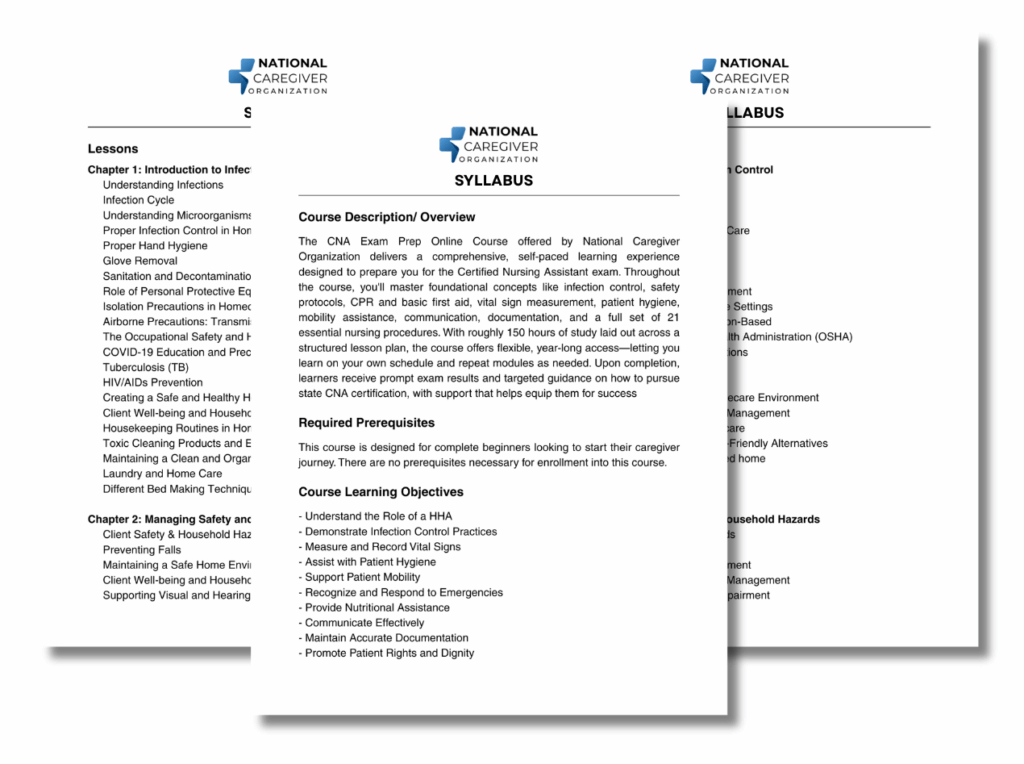
*Download this form and the above National Caregiver Organization syllabus will be emailed to your directly. By completing this form, you certify that you agree to National Caregiver Organization’s Terms and Conditions.*